
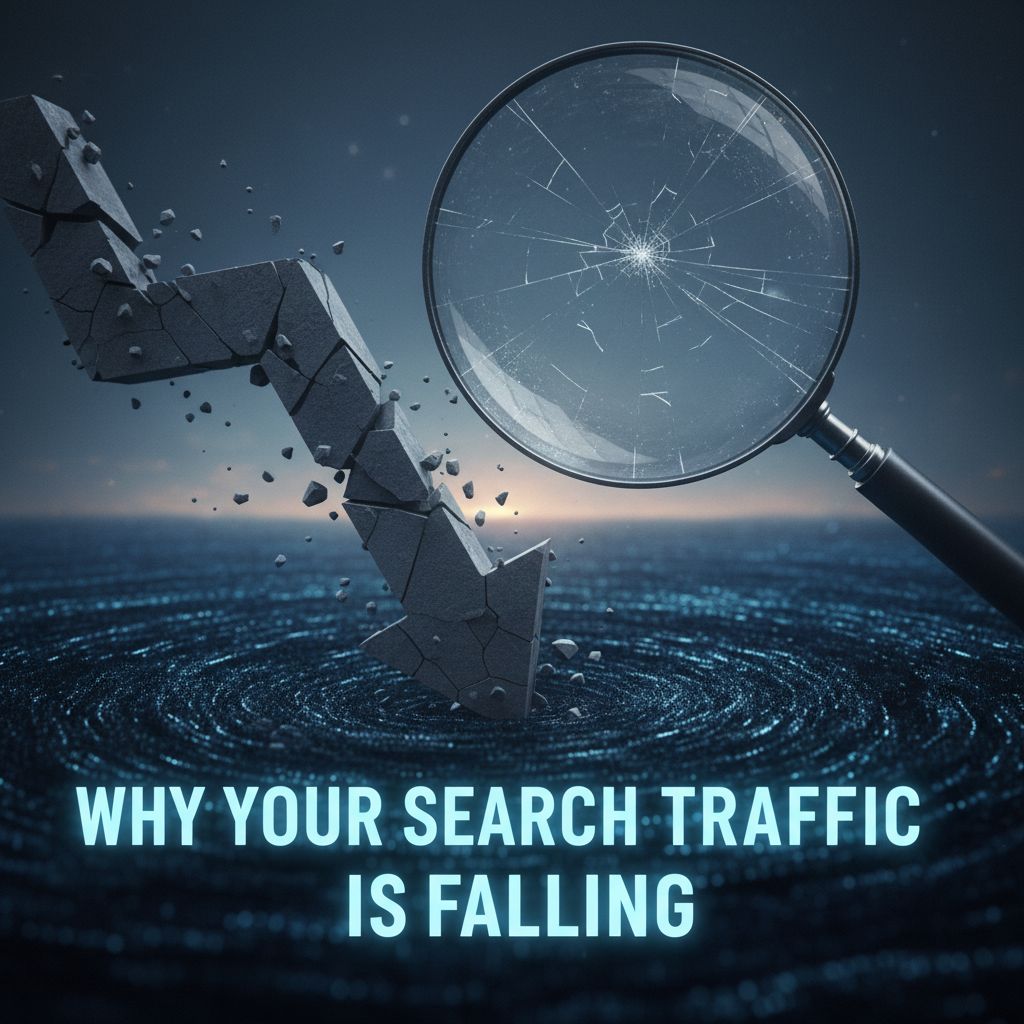
Your search traffic is falling because the rules of search have fundamentally changed and this is Why Your Search Traffic Is Falling — not because your SEO is broken. AI Overviews, conversational search, and zero-click results are answering your customers’ questions before they ever click a link. The businesses watching their Analytics numbers decline while doing everything their SEO agency told them to do are not failing. They are measuring the wrong thing. In 2026, the businesses winning are not chasing clicks. They are building the kind of multi-source authority that makes AI systems recommend them — and converting higher-intent visitors at rates traditional search never produced.
| Search traffic is falling for most businesses in 2026 not because of technical SEO failures but because AI Overviews and generative AI tools now answer up to 64% of queries directly, without requiring a click. Research from HubSpot’s State of Marketing 2026 Report found that 58% of marketers say their search volume is down but searches have higher intent — visitors are further along in their decision process when they do arrive. The correct response is not to try to recover lost clicks through traditional SEO tactics. It is to build the multi-source authority that earns AI citations, earn third-party media mentions that teach AI systems your business is credible, and optimise for the conversion of higher-intent, lower-volume traffic. Fewer clicks, better leads, and higher revenue per visitor is the new success metric. |
What You Will Learn in This Guide
- The specific data behind the traffic decline — and why it is structural, not fixable with more SEO
- Why 58% of marketers are seeing lower volume but higher intent — and what that actually means for revenue
- The three types of businesses experiencing this and how each should respond differently
- Why AI Overviews and zero-click results are not your enemy — and how to make them work for you
- The authority-building strategy that replaces lost click volume with AI citation volume
- How third-party news coverage and media mentions are now the fastest route to AI recommendation authority
- The new metrics that tell you whether your digital marketing is actually working in 2026
- Where to focus your time and budget for maximum impact right now
You Are Not Imagining It — The Traffic Drop Is Real and It Is Structural
If you opened Google Analytics recently and saw your organic traffic declining — despite publishing consistent content, maintaining good technical SEO, and doing everything your agency recommended — you are not alone, and you are not failing.
The decline is real. It is structural. And it is affecting nearly every business that relies on organic search traffic, across every industry and every market.
Here is what is actually happening. AI Overviews and generative AI tools now answer an estimated 15% to 64% of queries directly in the search results page — depending on the query type and category. Users read the answer at the top of the page and never click a link. Zero-click searches, which were already a growing trend before AI Overviews launched, have now reached approximately 60% of all Google searches. For informational and research queries — exactly the kind of queries that most small business content targets — zero-click rates are even higher.
The result: a business that ranked number one for an important keyword in 2023 can see its organic traffic from that keyword fall by 40% to 60% in 2026 — not because it lost its ranking, but because AI is answering the question above its listing and most users never scroll down to click.
At the same time, AI-powered search features have reduced organic traffic by 15% to 64% across categories according to multiple independent analyses. Pew Research found that links in Google’s AI summary results are clicked less than half as often as traditional links. And for businesses that invested heavily in informational content — the kind of content that drives top-of-funnel traffic — the impact has been particularly severe.
This is not a Google penalty. It is not a technical issue your developer can fix. It is not an algorithm update you need to recover from. It is a structural transformation in how search works — and it requires a structural response, not a tactical one.
The Silver Lining Nobody Is Talking About
Here is the finding that changes everything — and that most businesses have missed entirely because they are too focused on the declining traffic number.
HubSpot’s State of Marketing 2026 Report found that 58% of marketers say their search volume is down but their searches have higher intent — meaning visitors are further along in their buying journey when they do arrive.
Read that carefully. The customers who are still clicking through to your website in 2026 are better qualified than they were in 2023. They have already done more of their research — some of it via AI tools — before they arrive. They are closer to a purchasing decision. They are more likely to convert.
The businesses that understand this reframe their entire relationship with search traffic. They stop chasing lost click volume and start converting the higher-intent visitors they have more effectively. They stop measuring success by traffic numbers and start measuring it by revenue per visitor, conversion rate, and qualified lead volume.
The math often works in their favour. A business that moves from 10,000 monthly organic visitors converting at 2% (200 leads) to 4,000 monthly visitors converting at 6% (240 leads) has fewer clicks and more leads. That is the new reality — and businesses that measure it correctly discover that the AI era is not hurting their business. It is improving the quality of their pipeline while reducing the volume of their traffic.
But here is the critical condition: that higher conversion rate only materialises if AI systems are actively recommending your business — putting you in front of customers who arrive already having heard your name. If your business has low AI citation authority, you lose both the traffic and the AI-referred leads. The businesses in trouble are not those with declining click volume. They are the ones with declining click volume and no AI citation strategy to compensate.
The Three Types of Businesses — And How Each Should Respond
Not all businesses are experiencing this shift the same way. Understanding which type describes your situation determines your response strategy.
Type 1: The Informational Content Business
You built your traffic primarily on informational blog content — how-to articles, guides, explainers, educational resources. This is the category most severely affected by AI Overviews, because informational queries are exactly the queries AI answers most confidently and most frequently.
If your business model depends on converting informational traffic into leads, your strategy needs the most significant adjustment.
What to do: Stop producing thin informational content that AI can summarise better than you can. Instead, produce content so specific, so deeply expert, and so rich with original data that AI systems prefer to cite your content as a source rather than summarise it themselves. Publish proprietary research, first-person case studies with real numbers, and expert analysis that reflects genuinely unique professional perspective. When AI cannot do it better, it cites you instead.
Supplement this with a deliberate campaign to earn mentions in trusted third-party media — industry publications, news sites, podcasts, and community platforms. Each mention is a citation signal that teaches AI systems your business is an authority source. Services like Primetime Publishing distribute your content across 500+ high-authority news sites — publications that AI systems like ChatGPT and Google already trust as primary reference sources. That kind of multi-source media presence accelerates AI authority building in ways that website content alone cannot replicate.
Type 2: The Local Service Business
You rely on local search — Google Maps, local pack results, “near me” queries — to bring in customers. Your traffic may have declined less than informational content businesses, but you have noticed that calls and enquiries from search are changing in character.
Local search is being increasingly intermediated by AI. When someone asks “Who is the best plumber available this weekend in Nashville?” an AI assistant is handling that query — not showing a list of blue links. The businesses appearing in those AI-generated local recommendations are the ones with complete Google Business Profiles, strong review velocity, consistent entity data across every platform, and local content that specifically addresses their service area.
What to do: Your Google Business Profile is now your primary AI data feed — treat it as such. Complete every field, upload photos weekly, collect reviews systematically. Supplement with local content that is so geographically and professionally specific that no AI system can generate it from generic training data. And pursue local media mentions — even a single coverage story in a regional newspaper with DA 70+ generates the kind of trusted local citation signal that AI systems weight heavily for local recommendations.
Type 3: The E-Commerce or Product Business
Your traffic decline may be visible in category and comparison queries — the research-phase searches where customers were previously clicking through to evaluate options. AI is now doing that evaluation for them, presenting summaries of options before the customer ever visits a product page.
What to do: Make your product information machine-readable and AI-extractable. Implement Product schema and detailed, specific product descriptions. Get your products reviewed by independent sources — not just on your own website but on third-party review platforms, comparison sites, and editorial publications that AI systems already reference. The “As Seen On” credibility that comes from genuine third-party media coverage is particularly powerful for product businesses — it provides the external validation AI needs to recommend a product with confidence.
Why AI Citations Are Now More Valuable Than Clicks
Here is the shift in thinking that separates the businesses thriving in 2026 from the ones chasing lost traffic:
A click from traditional search was an opportunity. The customer arrived at your website and you had a chance to persuade them. Conversion rates for organic search traffic typically run between 2% and 5% for most small businesses.
An AI citation is a pre-sold referral. When an AI tool recommends your business by name, the customer arriving at your website has already cleared the trust threshold. They were told, by a system they trust, that your business is the answer. Research confirms this: AI-referred traffic converts at approximately 14% — roughly five times the conversion rate of traditional organic traffic.
This means that 200 visitors from AI citations can generate more revenue than 1,000 visitors from traditional organic search. The traffic volume is lower. The revenue impact is higher.
Building AI citation authority — the systematic process of making your business the entity that AI systems recommend — is therefore not a substitute for the traffic you have lost. It is a superior replacement. You get fewer visitors and more customers.
The businesses building this authority fastest are doing it on two fronts simultaneously: on-site (structured content, FAQ schema, direct-answer formatting, named expert authorship) and off-site (third-party media mentions, community citations, industry publication features, and distribution across trusted news networks).
The off-site component is where most businesses under-invest — and where the fastest AI authority gains are currently available. AI systems like ChatGPT and Google do not primarily trust what your website says about you. They trust what independent, third-party sources say about you. When hundreds of legitimate editorial sources — newspapers, TV news affiliates, industry magazines — are all publishing content that references your business, AI systems interpret that pattern as independently verified authority.
This is precisely why services that distribute your content across high-authority news networks are generating such dramatic AI visibility improvements for the businesses using them. A single campaign across 500+ real editorial sites with DA 45 to DA 86 produces citation signals across a network of sources that AI systems already treat as primary references. That is not a shortcut — it is the mechanism by which AI citation authority is actually built, working at scale and speed that individual outreach cannot match.
The New Metrics That Actually Tell You Whether Your Marketing Is Working
If you are still measuring your digital marketing performance primarily through organic traffic and keyword rankings, you are measuring inputs rather than outcomes — and you are missing the most important signals about whether your business is winning or losing in AI search.
Here are the metrics that actually matter in 2026:
AI share of voice: How often does your business name appear when AI tools answer questions relevant to your category? Run your 20-question monthly query test across ChatGPT, Perplexity, and Google AI Mode. Track the percentage of queries where you appear. This is the new version of “share of search” — and it is a far better predictor of future revenue than keyword rankings.
Branded search volume trend: Rising searches for your specific business name — measured in Google Search Console — indicate that AI systems are mentioning you to customers who then verify you by searching your name. Declining branded search is an early warning that AI mentions are falling.
Revenue per visitor: If traffic is declining but revenue per visitor is rising, your AI citation strategy is working. Higher-intent AI-referred traffic converts at higher rates — if your revenue per visitor is not improving alongside declining traffic volume, you may have a conversion problem rather than a traffic problem.
Conversion rate by traffic source: Segment your Google Analytics data by traffic source. Compare the conversion rate of direct traffic (which includes AI-referred customers who searched your name directly) against organic, paid, and referral. Rising direct traffic conversion rate indicates growing AI referral quality.
Citation source diversity: Track how many independent external sources mention your business — directories, review platforms, news publications, Reddit threads, YouTube citations. This is your citation density score, and it is a leading indicator of future AI recommendation frequency. More sources, higher diversity, more authority.
Lead quality trend: Are the leads arriving through your website better qualified than they were twelve months ago? Are they further along in their decision process? Do they require fewer touchpoints to convert? These are the signals of AI-era traffic quality improvement — and they show up in your sales process before they show up in your revenue numbers.
What to Do This Week: The Three-Priority Response Plan
Priority 1: Stop measuring the wrong things
Update your reporting framework this week. Add branded search volume tracking in Google Search Console. Add a monthly AI query test to your calendar. Track revenue per visitor in Google Analytics alongside session volume. If your reporting does not include these metrics, you are navigating without the instruments that matter.
Priority 2: Fix your on-site AI readiness
Audit your top five pages for AI extractability. Does each one open with a direct answer in the first sentence? Are subheadings written as questions? Is there a FAQ section with FAQPage schema on each page? If not, fix these before anything else. On-site AI optimisation is the foundation — without it, off-site authority building produces reduced returns.
Priority 3: Start building your off-site citation authority
This is the priority most businesses delay too long — and the one with the most immediate impact on AI citation rates.
Every independent, trustworthy external source that mentions your business is a vote of confidence that AI systems use when deciding whether to recommend you. Industry directory listings, review platforms, genuine Reddit contributions, guest articles in respected publications — all of these build citation authority that your own website cannot build alone.
For businesses that want to accelerate this process significantly, multi-publication news distribution services are producing measurable AI visibility improvements within weeks of deployment. Getting your brand and content published across hundreds of legitimate, high-DA editorial sites — the kind of publications that AI systems already treat as trusted references — generates the citation density that typically takes years of organic PR to build.
The strategy is straightforward: the more independent, credible sources confirm that your business is a legitimate, knowledgeable player in your category, the more confidently AI systems recommend you. Building that confirmation network is the central task of AI authority building in 2026 — and the businesses that start building it now will have a compounding advantage over those that wait.
Frequently Asked Questions
My organic traffic has been falling for six months. Is it too late to recover?
It depends what you mean by recover. If you mean recover the click volume from the informational queries that AI Overviews now answer directly — no, that traffic is largely gone and will not return. If you mean recover your business growth and lead volume — absolutely, and for many businesses the path to doing so produces better results than the traffic they lost. Build AI citation authority, improve your conversion rate for the higher-intent visitors who do arrive, and measure revenue per visitor rather than total sessions.
My SEO agency says I just need to produce more content. Is that right?
Producing more of the same content that AI now answers better than any website can is not the solution. The content strategy that works in 2026 is about depth, specificity, original data, and expert attribution — not volume. One comprehensive, data-rich, expert-attributed piece of content earns more AI citations than ten thin generic articles. Talk to your agency about shifting strategy toward AI-optimised content structure and off-site authority building, not just content volume.
How quickly will AI citation building replace my lost traffic?
The timeline depends on your starting point and the intensity of your authority building strategy. Businesses implementing on-site fixes (schema, FAQ sections, direct-answer formatting) typically see first AI citations within four to eight weeks. Businesses that combine on-site fixes with active off-site citation building — news distribution campaigns, directory listings, review collection, community contributions — typically see measurable AI share of voice improvement within 60 to 90 days. The compounding nature of citation authority means results accelerate over time.
Should I completely abandon traditional SEO?
No. Traditional SEO and AI search optimisation share the same foundation — quality content, domain authority, technical health, and trustworthy backlinks. The Semrush research confirms that AI Mode and LLMs pull data directly from Google’s top 10 results. Strong traditional SEO improves AI citation eligibility. The shift is in emphasis and measurement, not in abandoning the fundamentals.
Is there a service that can help me build news media authority quickly?
Yes — and this is one area where professional distribution can dramatically accelerate what would otherwise take years of individual outreach. Services like Primetime Publishing distribute your content across 500+ legitimate editorial sites — TV news affiliates, regional newspapers, and magazines with DA scores averaging 45 and reaching up to DA 86. These are precisely the kinds of publications that AI systems like ChatGPT and Google already reference as trusted sources. A single campaign generates the kind of multi-source editorial presence that AI systems interpret as independently verified authority — and you get legitimate “As Seen On” credibility for your own marketing materials. For businesses serious about building AI citation authority quickly, this kind of third-party distribution is one of the highest-leverage investments available right now.
The Bottom Line
Your search traffic is falling because the search landscape has fundamentally changed — not because you have done anything wrong. AI Overviews, conversational search, and zero-click results are answering your customers’ questions before they reach your website, and that pattern will deepen, not reverse.
The businesses thriving in this environment are not the ones who found a way to recover their lost click volume. They are the ones who recognised that the new metric is AI share of voice, not organic traffic rank. They shifted from optimising for clicks to optimising for recommendations. And they built the multi-source, third-party citation authority that teaches AI systems to name their business whenever a relevant customer question is asked.
The traffic you lost to AI Overviews is not coming back. The customers AI recommends to your business are worth more than the traffic you lost. Building the authority to earn those recommendations is the most important marketing investment you can make in 2026.
Start with your metrics this week. Measure what matters. Fix your on-site foundations. Then build the citation authority that makes AI recommend you — and watch your conversion rate tell the story your traffic number never could.
Published by Business Startup Support — practical strategies for founders, startups, and small business owners who want to grow smarter. Visit businessstartupsupport.com
Looking to build your news media authority quickly? Explore Primetime Publishing — content distribution across 500+ legitimate TV news, newspaper, and magazine sites that AI systems already trust. Visit businessstartupsupport.com for details.
Complete Series: The Business Startup Support AEO, SEO, and GEO Guide
- SEO vs AEO: What’s the Difference and Which One Should Your Business Focus On in 2026?
- How Do I Get My Business Recommended by ChatGPT and Google AI Overviews?
- What Kind of Content Makes AI Search Engines Recommend My Business Over Competitors?
- Does My Local Business Need AEO, or Is Google Maps and Local SEO Enough?
- Why Your Ad Spend Isn’t Training AI to Recommend You
- The 5-Channel Visibility Framework for Business Owners in 2026
- What Is GEO (Generative Engine Optimization) and How Is It Different From SEO and AEO?
- How to Write a Perfect FAQ Page That Gets Cited by AI Search Engines
- Why Your Business Is Invisible in AI Search Results — And the Exact Steps to Fix It in 30 Days
- Your Competitors Are Being Recommended by AI Search Engines — Here’s How to Catch Up and Overtake Them
- How to Get Your Business Found, Trusted, and Chosen by AI Search Engines
- Stop Wasting Your Marketing Budget: How to Get AI Search Engines to Recommend Your Business for Free
- The Small Business Owner’s Guide to Earning AI Search Recommendations — Without a Marketing Team or Big Budget
- Why 85% of What Your Customers Ask AI Has Nothing to Do With Your Keywords
- How to Use YouTube and Reddit to Get Your Business Recommended by AI Search Engines
- How to Build Topical Authority That Makes AI Search Engines Treat Your Business as the Go-To Expert
- The AI Search Visibility Audit: How to Know Exactly Where Your Business Stands — And Fix It Fast
What Is Agentic AI and Why It Will Change How Customers Find and Buy From Your Business by 2028
Author


I Disagree: Winning Arguments Without Losing Friends
$14.18 (as of October 7, 2026 16:08 GMT +00:00 – More infoProduct prices and availability are accurate as of the date/time indicated and are subject to change. Any price and availability information displayed on [relevant Amazon Site(s), as applicable] at the time of purchase will apply to the purchase of this product.)
Traction: Get a Grip on Your Business
$10.48 (as of October 7, 2026 16:07 GMT +00:00 – More infoProduct prices and availability are accurate as of the date/time indicated and are subject to change. Any price and availability information displayed on [relevant Amazon Site(s), as applicable] at the time of purchase will apply to the purchase of this product.)
Simplify: Do 50 Percent More with 50 Percent Less
$30.00 (as of October 7, 2026 16:08 GMT +00:00 – More infoProduct prices and availability are accurate as of the date/time indicated and are subject to change. Any price and availability information displayed on [relevant Amazon Site(s), as applicable] at the time of purchase will apply to the purchase of this product.)
Grit: The Power of Passion and Perseverance
$9.09 (as of October 7, 2026 16:07 GMT +00:00 – More infoProduct prices and availability are accurate as of the date/time indicated and are subject to change. Any price and availability information displayed on [relevant Amazon Site(s), as applicable] at the time of purchase will apply to the purchase of this product.)


Leave a Reply