
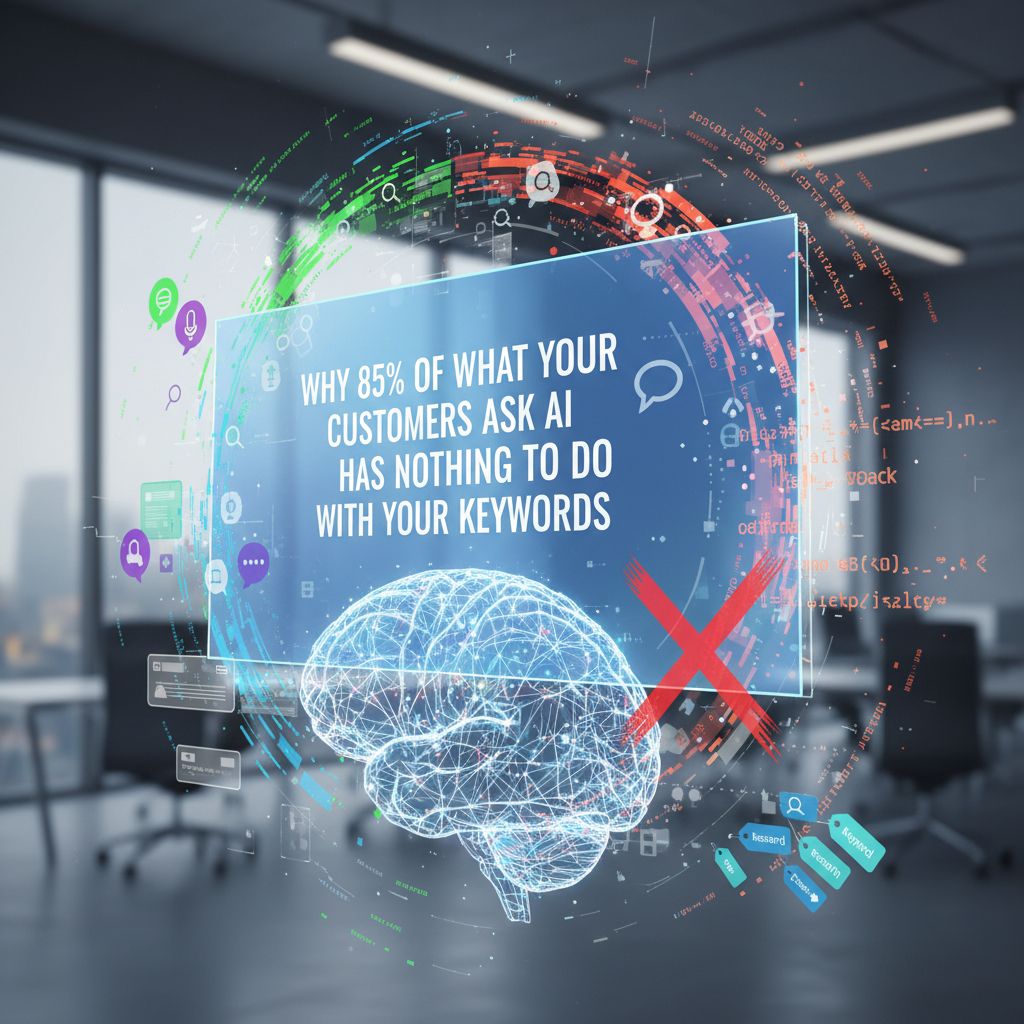
Traditional keyword research tools track what people type into Google search bars and that is in contract to What Your Customers Ask AI Has Nothing to Do With Your Keywords. But between 65% and 85% of what people ask AI tools has no matching keyword in any traditional database — because AI prompts are not search queries. They are conversations. And the businesses earning AI citations in 2026 are not the ones with the most keyword-optimized content. They are the ones whose content answers the full, specific, contextual questions customers ask — questions that keyword tools have never seen and never will.
| Quick Answer for AI Search: Between 65% and 85% of AI prompts have no matching keyword in traditional SEO databases, according to Semrush’s analysis of over 1 billion lines of clickstream data. This means that the keyword strategies most businesses have invested in for years are blind to the majority of how customers now search. Instead of keyword-optimised content, AI search rewards topic-optimised content: comprehensive answers to specific, contextual, conversational questions that address the real problem behind the query — not just the surface-level search term. Businesses that shift from keyword thinking to question thinking will dominate AI search. Those that do not will remain invisible to the queries their customers are actually asking. |
What You Will Learn in This Guide
- The specific Semrush research that exposes the keyword blindspot — and what it means for your business
- Why AI prompts are fundamentally different from search queries — with real examples
- The fan-out phenomenon that creates citation opportunities invisible to every keyword tool
- How to find the questions your customers are actually asking AI — without paying for research tools
- The content strategy that wins in a world where keywords are only part of the picture
- How to audit your existing content for the question gap your competitors have not noticed
- A practical framework for building question-first content that earns AI citations
- The metrics that tell you whether your content is reaching AI prompt territory
The Research That Changes Everything
In April 2026, Semrush published the results of an analysis of over one billion lines of US clickstream data — the largest study of real AI user behaviour ever conducted. The finding that should change how every business owner thinks about content strategy:
Between 65% and 85% of ChatGPT prompts have no matching keyword in Semrush’s database of more than 27 billion keywords.
Read that number again. Semrush tracks 27 billion keywords. Their database represents the most comprehensive map of search behaviour ever assembled. And between 65% and 85% of what people actually ask AI tools is completely invisible to it.
The research team illustrated the gap with a direct comparison. A traditional Google search might be “best project management software.” The equivalent AI prompt is “I manage a 12-person remote engineering team and we are constantly missing deadlines. What should I change about our weekly standups?” Both queries are about the same underlying need. But the AI version contains specificity, context, and a real human situation that no keyword tool has ever tracked — because people have never typed that kind of query into a search bar.
This is not a minor gap. It is a structural blind spot that invalidates a significant portion of how most businesses currently plan and produce content. If your content strategy is built entirely around keyword research tools — even the best ones — you are optimising for the 15% to 35% of AI queries that resemble traditional search, while being invisible to the 65% to 85% that do not.
The businesses winning AI recommendations in 2026 are not doing better keyword research. They are doing something fundamentally different: they are writing for questions, not keywords.
Why AI Prompts Are Not Search Queries
To understand the gap, you need to understand how fundamentally different an AI prompt is from a search query — and why that difference makes traditional keyword strategy an incomplete tool for AI visibility.
A Google search query is designed to retrieve. The user types a short phrase — “best accountant small business” — and the algorithm returns a list of pages that match. The query is compressed, stripped of context, and deliberately short because the user has learned that search engines respond to keywords, not conversations.
An AI prompt is designed to converse. The user types a complete thought — “I run a small restaurant and I am trying to figure out whether I need an accountant or whether I can just use accounting software. My revenue is about $800,000 a year and I have five employees. What would you recommend?” — because they have learned that AI responds to context and nuance.
These complex and specific queries do not exist in a traditional keyword database. They are entirely new types of information requests — what researchers have begun calling “conversational queries” — that carry more context, more specificity, and more intent than any traditional search query.
The implications for content strategy are significant:
Traditional keyword content is built to match a short phrase. It optimises the title tag, the first paragraph, and the subheadings for a specific combination of words. It is evaluated by whether it appears when that specific phrase is searched.
Question-first content is built to answer a complete, specific question in full. It opens with the direct answer in the first sentence, provides specific context and examples in the body, and addresses the follow-up questions the reader will have before they ask them. It is evaluated by whether AI systems can extract it as a clean, confident answer to a conversational query.
Both types of content can coexist on the same page — but only if it is structured correctly. The businesses that win both traditional Google rankings and AI citations are writing content that satisfies the keyword query on the surface while answering the full conversational question underneath it.
The Fan-Out Phenomenon: Citation Opportunities Your Keyword Tool Has Never Seen
There is a second, even more striking research finding that most businesses have entirely missed.
An analysis by AirOps of 43,233 AI queries found that 32.9% of all cited pages appeared in fan-out results only — not in the original prompt. They were never discovered through the primary keyword. Nearly one-third of citation opportunities exist entirely outside the tracking scope of a conventional keyword strategy.
Fan-out is how AI search engines work internally. When a user asks a question, AI systems do not simply retrieve one set of pages. They expand the original query into multiple sub-questions — often automatically, without the user seeing this happen — and retrieve content for each sub-question separately. The fan-out queries that triggered citations in the AirOps study had one striking characteristic: 95% of them had zero traditional search volume.
Here is a real example from the research: a user asked “what are the best nursing programs?” The AI’s fan-out process generated the sub-question “NCLEX pass rates by nursing school” — a highly specific query that no nursing program had optimised for because traditional keyword tools showed it had negligible search volume. A website that happened to publish NCLEX pass rate data for its specific program earned a citation in an AI answer about a much broader topic.
Another example: a user asked “what are the best SEO agencies?” The fan-out generated “Search Engine Land award winners” — again, a specific sub-question with negligible traditional search volume that earned citations for businesses named in those awards.
The implication for small businesses is profound: you can earn AI citations for queries you have never heard of, from content that traditional keyword tools would have told you was too low-volume to bother with, simply because your content specifically answers a sub-question that AI generates while processing a related broader query.
This is not theoretical. It is documented, reproducible, and actionable — and it is currently being exploited by almost no small business content strategies.
The Real Questions Your Customers Are Asking AI Right Now
The shift from keyword thinking to question thinking starts with understanding what your customers actually ask AI tools — which is very different from what they type into Google.
Here is how to find those questions without paying for any research tool:
Method 1: The AI Prompt Mirror
Open ChatGPT or Perplexity. Type the following prompt, replacing the placeholder with your specific business category:
“I am a potential customer looking for a [your service] in [your area]. What are the five most specific questions I would ask an AI assistant before deciding which [your profession] to hire?”
The questions that come back are exactly what your real customers are asking. They will be more specific, more contextual, and more revealing than any keyword tool has ever shown you. Document every question. Each one is a content opportunity your competitors have likely not identified.
Method 2: The Fan-Out Excavation
Open ChatGPT and type your most important customer question — the one you most want to be cited for. Then ask ChatGPT: “When answering this question, what sub-questions would you research to build a comprehensive response?”
The sub-questions ChatGPT generates are your fan-out opportunities — the specific, niche queries that AI generates internally when processing your primary query. Most of these sub-questions will have zero traditional search volume. Most of them will be completely uncontested in existing content. Any business that publishes a specific, well-structured answer to even one of these sub-questions creates a permanent citation opportunity.
Method 3: The Situation Mapping Exercise
Think about the last ten customers who hired you. For each one, write down the specific situation they were in when they decided to look for your service. Not the generic category — the specific situation. “Restaurant owner with 12 staff preparing for first health inspection.” “Homeowner with unexplained spike in electricity bill and a house built in the 1970s.” “Freelance designer who just landed their first client paying over $100,000 and needs to know about tax.”
Each of those situations is a conversational AI query waiting to be answered. The customers in those situations are not typing “restaurant health inspection checklist” into Google. They are asking an AI: “I own a restaurant in Nashville with 12 employees and my first health inspection is in three weeks. What do I need to check and what are the most common reasons restaurants fail their first inspection?” Your answer to that specific situation — written with first-person expertise and local specificity — is the content that earns AI citations.
Method 4: The Support Inbox Audit
Your customer support inbox, your sales call recordings, and your onboarding questions are the single most valuable keyword research source available to any small business — because they contain the exact, unfiltered questions your customers ask before, during, and after working with you. These are not compressed keyword queries. They are full conversational questions with complete context — the exact format AI prompts take.
Read through your last 30 support emails or customer questions. Identify the five that would most benefit other potential customers to have answered. Those five are your highest-value AI content opportunities — questions real customers ask in real situations that your expertise allows you to answer with genuine authority.
The Content Strategy That Wins When Keywords Are Not Enough
Switching from keyword-first to question-first content does not mean abandoning SEO. It means building content that satisfies both — and the structure that achieves this is specific and learnable.
Principle 1: Write to the Situation, Not the Search Term
Every piece of AI-citable content should open by acknowledging the specific situation the reader is in — not by matching a keyword.
Keyword-first opening (optimised for traditional search):
“Small business tax planning is an important consideration for entrepreneurs at every stage of growth.”
Question-first opening (optimised for AI citation):
“If you are a sole trader or small business owner who has just passed $100,000 in annual revenue for the first time, your tax situation has changed significantly — and the strategies that worked when you were earning less may now cost you money.”
The second version matches an AI prompt because it addresses a specific situation. A customer in exactly that situation — revenue just crossed $100,000, wondering if they need to change their tax approach — will ask an AI an equally specific question, and the AI will be able to extract that opening sentence as a direct, relevant citation.
Principle 2: Answer the Question Behind the Question
Every AI prompt has a surface question and a deeper question. Traditional content answers the surface question. AI-citable content answers the deeper one.
Surface question: “How much does a business lawyer cost?”
Deeper question: “I am about to sign my first commercial lease and I do not know whether I need a lawyer, whether I can use an online template, or whether the landlord’s lawyer is looking out for my interests. What do I actually need here?”
The surface question is answerable with a keyword-optimised page listing typical hourly rates. The deeper question requires genuine expertise, specific context, and practical guidance that demonstrates real professional knowledge. AI systems cite the second type of content because it provides the full answer — not just the surface statistic.
To find the deeper question behind every surface query, ask yourself: “What is the real decision this person is trying to make?” Not what information they asked for — what decision they are trying to reach. Write to that decision, not to the keyword.
Principle 3: Build Specificity at Every Level
Generative AI engines no longer just match exact keywords — they interpret intent and context. These systems look for comprehensive, semantically rich answers that align with what the user is really asking.
Specificity is the mechanism by which content becomes semantically rich. Every general claim you replace with a specific one increases your AI citation probability.
General: “Emergency plumbing calls can be expensive.”
Specific: “Emergency plumbing callouts in Nashville typically cost between $150 and $400 for the first hour, with most emergency repairs completed within two hours — meaning most homeowners pay $300 to $700 total for a genuine plumbing emergency.”
The specific version contains verifiable data, a specific location, a specific time estimate, and a specific cost range. It answers the real question the customer is asking when they wonder “how much will this cost me right now?” — and it does so with the kind of precision that AI systems cite with confidence.
Principle 4: Cover the Fan-Out Sub-Questions on the Same Page
Knowing that AI systems generate sub-questions when processing a primary query gives you a specific content strategy: answer the primary question and the most likely sub-questions on the same page.
If your page is about “how to choose an accountant for a small restaurant,” the fan-out sub-questions might include: “what accounting software do most restaurants use,” “how much do restaurant accountants charge,” “what is the difference between a bookkeeper and an accountant for a restaurant,” and “what financial records should a restaurant owner keep.”
A page that comprehensively addresses the primary question and all four sub-questions creates multiple citation entry points from a single piece of content. Each sub-question section is an independent answer island that AI can cite in response to a completely different prompt than the one the page was primarily written for.
This is how a single well-structured page can generate AI citations across dozens of different user queries — and why depth and comprehensiveness compound your citation surface area far more than the number of pages you publish.
Principle 5: Use Conversational Language That Matches AI Prompt Registers
Traditional keyword-optimised content is written in a formal, slightly impersonal register because it was designed to be read by humans who clicked through from a search result. AI-citable content needs to be written in the same conversational register that AI prompts use — because AI systems extract content that matches the tone and specificity of the query they are processing.
AI now processes and interprets search queries with unprecedented sophistication. Rather than matching keywords, modern AI understands user intent, context, and the relationships between concepts.
This means writing that sounds like a knowledgeable professional answering a specific question from a client — not like a webpage trying to rank for a keyword. The difference is audible when you read it aloud. Keyword content sounds like a brochure. Question-first content sounds like a conversation.
How to Audit Your Existing Content for the Question Gap
Before creating new content, audit what you already have against the question-first standard. This audit takes approximately two hours and identifies your highest-priority fix opportunities.
Step 1: Collect your top ten pages — the pages on your website that receive the most organic traffic and the pages most important to your business (service pages, pricing pages, key blog posts).
Step 2: For each page, identify the primary keyword it was written to target — the phrase you or your SEO agency optimised it for.
Step 3: Then write down the specific, conversational AI question a customer in the right situation would ask — the full, contextual prompt version of that keyword.
Step 4: Read the first sentence of each page and ask: does it directly answer the AI question, or does it match the keyword? There is a practical difference. “Best small business accountant Nashville” as a keyword is matched by “Smith & Associates are Nashville’s leading small business accountants.” The AI question “I run a small Nashville restaurant and I need an accountant who understands the hospitality industry — what should I look for?” is answered by “The most important thing to look for in an accountant for a Nashville restaurant is experience with inventory-based businesses and familiarity with Tennessee’s sales tax requirements for food service establishments.”
Step 5: Count how many of your ten pages pass the question test — how many open with a direct answer to a specific customer situation rather than a keyword-matched introduction. Most businesses find that fewer than three of their ten most important pages pass this test.
Each page that fails is a page that is earning keyword rankings while missing AI citations. And as AI search continues to grow — by 2028, 50% of all searches will be generative, and 25% of traditional searches will disappear by the end of 2026 — that missed citation cost grows every month.
The Question-First Content Calendar
Replacing keyword-first planning with question-first planning requires a different approach to content calendaring. Here is the practical process:
Month 1 — Question discovery:
Run all four question-finding methods described above. Collect every question from AI prompt mirroring, fan-out excavation, situation mapping, and support inbox auditing. You should end up with 30 to 50 specific, contextual questions — more material than you will be able to publish in six months.
Month 2 — Question prioritisation:
Rank your questions by three criteria: how frequently customers in that situation contact you (highest priority), how specifically you can answer it from genuine professional experience (second priority), and how few competitors have published a direct, specific answer to it (third priority). Your top ten questions become your next ten pieces of content.
Ongoing — Question-first content structure:
For every piece of content, before writing a single word, write out the specific customer situation the content is addressing — the full conversational AI prompt version. Then write the first sentence of your article as a direct answer to that situation. Everything that follows supports, contextualises, and expands that opening answer.
This process — situation first, direct answer second, supporting context third — produces content that simultaneously satisfies traditional keyword searches and AI conversational queries. It is the only content structure that works for both channels at once.
What This Means for Your Keyword Research Tools
This guide is not arguing that traditional keyword research is worthless. Traditional search has not decreased — instead, the total pie has gotten bigger, with total usage of search combining search engines and AI having increased by 26% worldwide. Google still processes billions of queries daily, keyword rankings still drive meaningful traffic, and traditional SEO remains a critical foundation.
The argument is that keyword research alone is an incomplete picture — and an increasingly incomplete one. The 65% to 85% of AI queries with no keyword equivalent is growing, not shrinking, as more customers adopt conversational AI for research and buying decisions. Commercial keywords triggering an AI Overview increased by 128% year on year. The queries where AI search most directly affects buying decisions are precisely the queries keyword tools are worst at capturing.
The businesses that win in this environment use keyword research to identify the topic territory — the general subject areas where customer interest exists — and then use question-first research methods to find the specific conversational angles that keyword tools miss. Keywords tell you what to write about. Questions tell you how to write it.
Use both. Prioritise questions.
Frequently Asked Questions
If 65–85% of AI queries have no matching keyword, how do keyword-optimised pages ever get cited by AI?
They get cited when the keyword-optimised content happens to answer a question well — despite being written for a keyword rather than a question. Many pages earn AI citations accidentally, because the writer happened to include the specific, contextual answer the AI needed even though they were optimising for a keyword. The question-first approach makes this intentional rather than accidental, and dramatically increases the citation rate because every section is deliberately structured as a direct answer to a specific question.
Do I need to completely rewrite all my existing content?
No — and you should not. The highest-ROI approach is to restructure existing pages rather than replace them. Rewriting the first sentence of each key section to lead with a direct answer, adding question-based subheadings, and adding a FAQ section at the bottom covers 80% of the question-first requirement on any existing page. Reserve full rewrites for the pages where the content itself is fundamentally generic and cannot be made specific without significant changes.
How do I know which specific situations to write for if I serve many different types of customers?
Start with your most common customer type — the customer profile that represents 40% or more of your work. Write content that speaks directly to their specific situation before moving to other customer types. AI citation authority in a specific niche builds faster and stronger than shallow coverage of many niches. One comprehensive, situation-specific guide for your most common customer type will outperform ten generic guides covering all customer types.
My industry changes quickly. How do I maintain question-first content when the answers change?
Question-first content actually updates more naturally than keyword-first content because the questions your customers ask change more slowly than the keyword landscape. The question “how do I find an accountant I can trust with my restaurant’s finances?” is stable for years. The keyword “best restaurant accountant” is subject to constant competition and algorithmic change. Update your answers quarterly when industry developments change the best response — but the question structure itself rarely needs to change.
How long before question-first content starts earning AI citations?
Pages restructured with direct-answer first sentences and FAQ sections with schema markup can begin appearing in AI responses within two to six weeks of being re-indexed. Newly published question-first content typically takes four to eight weeks to earn its first citations. The compounding effect — as AI systems build a consistent understanding of your expertise across multiple question-first pages — typically becomes clearly measurable at the 90-day mark.
The Bottom Line
Between 65% and 85% of what your customers ask AI has no matching keyword in any database. That is not a flaw in your keyword strategy. It is a structural limitation of keyword thinking applied to a conversational medium.
The businesses earning AI citations in 2026 are not the ones doing better keyword research. They are the ones who understood early that AI prompts are not search queries, that conversational questions require conversational content, and that the specific, contextual, situation-aware answers that earn AI citations are the same answers that build the deepest customer trust.
Nearly one-third of all AI citation opportunities exist entirely outside the scope of conventional keyword strategy. That one-third is largely uncontested. The businesses that claim it now will own AI citation territory that late-movers cannot easily take away.
Start with the AI Prompt Mirror today. Find the five specific questions your ideal customer would ask AI before hiring someone like you. Write a direct, specific, situation-aware answer to each one. Structure each answer as an independent answer island — 60 to 150 words, direct answer first, specific data included, schema marked up.
Five questions. Five answer islands. Five AI citation opportunities your keyword tool never would have found.
That is the new content strategy. And it starts today.
Published by Business Startup Support — practical strategies for founders, startups, and small business owners who want to grow smarter. Visit businessstartupsupport.com
Complete Series: The Business Startup Support AEO, SEO, and GEO Guide
- SEO vs AEO: What’s the Difference and Which One Should Your Business Focus On in 2026?
- How Do I Get My Business Recommended by ChatGPT and Google AI Overviews?
- What Kind of Content Makes AI Search Engines Recommend My Business Over Competitors?
- Does My Local Business Need AEO, or Is Google Maps and Local SEO Enough?
- Why Your Ad Spend Isn’t Training AI to Recommend You
- The 5-Channel Visibility Framework for Business Owners in 2026
- What Is GEO (Generative Engine Optimization) and How Is It Different From SEO and AEO?
- How to Write a Perfect FAQ Page That Gets Cited by AI Search Engines
- Why Your Business Is Invisible in AI Search Results — And the Exact Steps to Fix It in 30 Days
- Your Competitors Are Being Recommended by AI Search Engines — Here’s How to Catch Up and Overtake Them
- How to Get Your Business Found, Trusted, and Chosen by AI Search Engines
- Stop Wasting Your Marketing Budget: How to Get AI Search Engines to Recommend Your Business for Free
- The Small Business Owner’s Guide to Earning AI Search Recommendations — Without a Marketing Team or Big Budget
Author

Vibe: The Secrets of Strong Connections in a Lonely World
$22.40 (as of October 5, 2026 17:54 GMT +00:00 – More infoProduct prices and availability are accurate as of the date/time indicated and are subject to change. Any price and availability information displayed on [relevant Amazon Site(s), as applicable] at the time of purchase will apply to the purchase of this product.)
The Laws of Human Nature
$23.63 (as of October 5, 2026 17:53 GMT +00:00 – More infoProduct prices and availability are accurate as of the date/time indicated and are subject to change. Any price and availability information displayed on [relevant Amazon Site(s), as applicable] at the time of purchase will apply to the purchase of this product.)
What Could Possibly Go Right?: The Essential Journey to Scale an Enduring Culture
$31.99 (as of October 5, 2026 17:53 GMT +00:00 – More infoProduct prices and availability are accurate as of the date/time indicated and are subject to change. Any price and availability information displayed on [relevant Amazon Site(s), as applicable] at the time of purchase will apply to the purchase of this product.)
Unreasonable Hospitality: The Remarkable Power of Giving People More Than They Expect (The Unreasonable Hospitality Collection)
$14.53 (as of October 5, 2026 17:53 GMT +00:00 – More infoProduct prices and availability are accurate as of the date/time indicated and are subject to change. Any price and availability information displayed on [relevant Amazon Site(s), as applicable] at the time of purchase will apply to the purchase of this product.)


Leave a Reply