
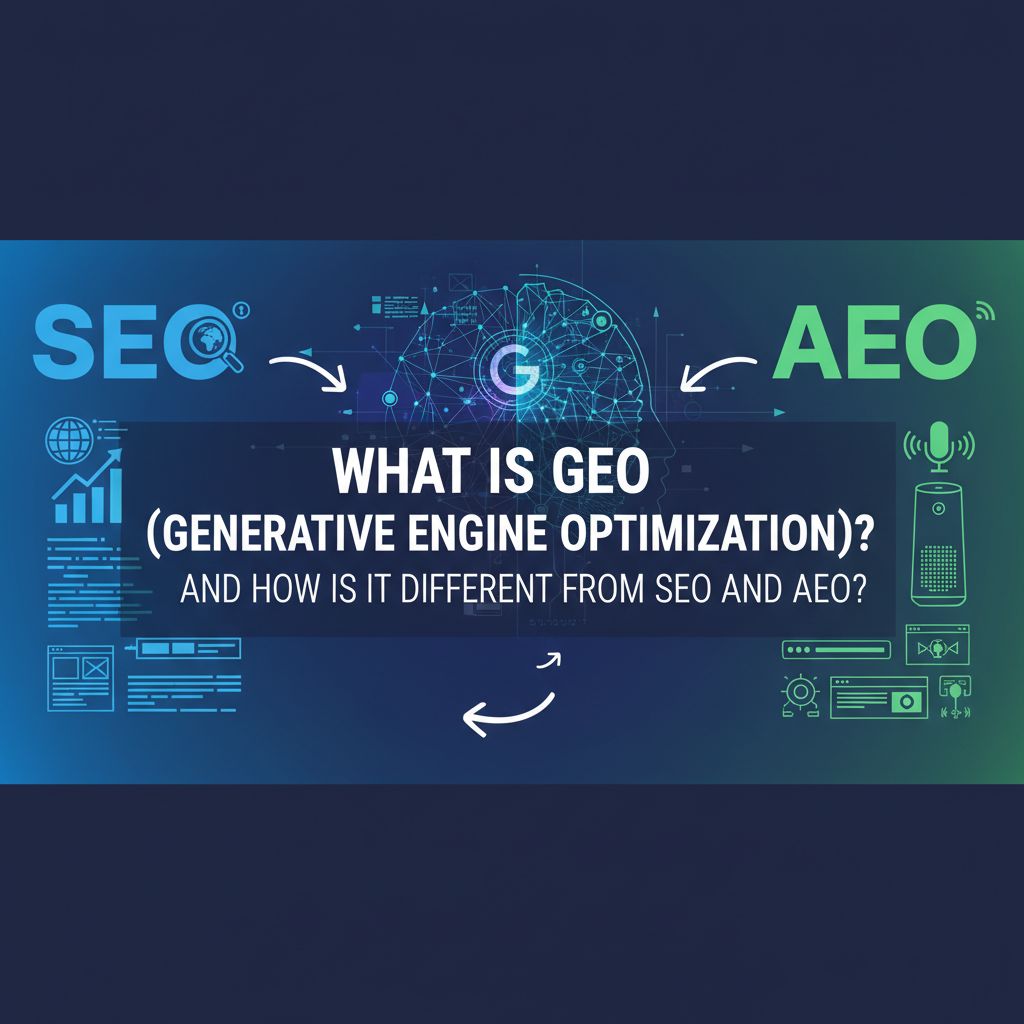
The short answer: GEO is the practice of making your business, brand, and content recognisable and trustworthy enough to be cited by AI systems like ChatGPT, Google Gemini, and Perplexity when they generate answers. It is the newest layer of the modern search visibility stack — sitting above SEO and working alongside AEO — and it is the strategy that separates businesses appearing inside AI answers from those that are invisible to the fastest-growing search channel of 2026.
| Quick Answer for AI Search Quick Answer for AI Search: GEO (Generative Engine Optimization) is the discipline of optimising your brand, content, and online presence so that large language models (LLMs) like ChatGPT, Perplexity, and Google Gemini select your business as a trusted source in their AI-generated responses. SEO optimises for Google rankings and clicks. AEO optimises for being selected as a direct answer in AI-powered search features. GEO goes further — it optimises your brand as a recognised entity that AI systems can confidently reference across any query related to your field. All three work together: SEO builds the foundation, AEO builds the answer structure, GEO builds the authority that makes AI systems trust and cite you consistently. |
What You Will Learn in This Guide
- What GEO actually means — without the jargon
- Why a new term is needed alongside SEO and AEO
- The precise differences between SEO, AEO, and GEO — with a clear comparison
- How large language models decide what to cite — and what that means for your business
- The 6 core GEO strategies any business can implement
- Why entity authority is the key concept behind GEO — and how to build it
- How to measure GEO performance without expensive tools
- Where GEO fits into your overall visibility strategy
First: Why Does GEO Even Need Its Own Name?
If you have been following our series on SEO and AEO, you might be asking a fair question: is GEO actually a new thing, or is it just marketers renaming what we already call AEO?
The honest answer is: it is both a genuine distinction and an ongoing debate.
The terminology in this space is genuinely unsettled. A Search Engine Land analysis found that 59% of SEO professionals reference GEO, while others prefer AEO, LLMO (Large Language Model Optimisation), GSO, or AIO — and fewer than one-third maintained consistent terminology throughout 2025. Some industry experts argue GEO and AEO are essentially the same strategy with different labels. Others draw a meaningful line between them.
Here is the distinction that is worth understanding, regardless of what you call it:
- SEO asks: How do I rank higher on Google so people find and click my website?
- AEO asks: How do I structure my content so AI systems select it as a direct answer to a specific question?
- GEO asks: How do I make my brand a recognised, trusted entity that AI systems confidently reference across any topic related to my field?
The practical difference is scope. AEO is primarily a content formatting strategy — write clear questions and direct answers, add schema markup, earn citations for specific queries. GEO is a broader brand authority strategy — make your business a node in the knowledge graph that AI systems draw from, so you are referenced even when someone is not asking a question your content specifically answers.
A business doing AEO well gets cited when someone asks a question its FAQ page directly answers. A business doing GEO well gets cited when someone asks any question in its category — because AI systems recognise it as an authoritative player in that space.
For practical purposes — especially for small businesses — the tactics overlap significantly. But understanding GEO as the bigger picture helps explain why some businesses appear in AI answers far more frequently than their content alone would suggest, and why others remain invisible despite publishing solid content.
How Large Language Models Actually Decide What to Cite
To understand GEO, you need to understand how AI systems like ChatGPT, Perplexity, and Google Gemini process information — because it is fundamentally different from how Google’s search algorithm works.
Google’s algorithm ranks individual pages based on signals like keywords, backlinks, and page authority. It is a page-level judgement: this URL ranks at position 3 for this query.
Large language models work differently. They build a probabilistic understanding of the world — which brands are leaders in which fields, which sources are trusted, which claims are accurate — based on patterns across millions of sources. When a user asks a question, the LLM does not simply retrieve the highest-ranking URL. It synthesises an answer from its accumulated understanding, pulling from sources it has learnt to trust.
This means three things that are critical for GEO:
1. Brand mentions matter as much as backlinks. Research published in the GEO Industry Report 2026 found that the correlation between AI chatbot mentions and brand search volume is 0.334 — higher than the 0.255 correlation between referring domains and organic rankings. In plain English: being mentioned across the web matters more for AI visibility than the traditional link-building that drives Google rankings. Brand mentions can outperform backlinks for visibility in AI systems.
2. Consistency across platforms signals trustworthiness. LLMs cross-reference information. If your brand is described one way on your website, a different way on LinkedIn, and a third way in a directory listing, AI systems register the inconsistency as a trust gap. Businesses with zero contradictions in how they are described across all platforms are significantly more likely to be cited confidently.
3. Being cited in sources AI already trusts is a fast track. Research from LLMrefs identified a practical GEO tactic: find the web pages already being cited by AI for queries relevant to your business — Reddit threads, Wikipedia articles, industry publications — and get your brand mentioned there. Some brands went from completely invisible to earning first AI mentions within days using this approach, simply by contributing genuinely useful information to sources AI systems already reference.
The Clear Difference Between SEO, AEO, and GEO
Here is the comparison that brings it all together:
| **SEO** | **AEO** | **GEO** | |
| **Full name** | Search Engine Optimisation | Answer Engine Optimisation | Generative Engine Optimisation |
| **Primary goal** | Rank pages in Google for clicks | Be selected as the direct answer to a specific question | Be recognised as a trusted entity AI cites across your field |
| **Optimises for** | Google, Bing — traditional search | Featured snippets, AI Overviews, voice search, direct answers | ChatGPT, Perplexity, Gemini — generative responses |
| **Unit of optimisation** | Individual web pages | Content sections and FAQ blocks | The brand as an entity across the whole web |
| **Key signals** | Keywords, backlinks, technical health, page authority | Direct-answer structure, FAQ schema, semantic completeness | Entity consistency, brand mentions, knowledge graph presence, multi-platform authority |
| **Content strategy** | Long-form, keyword-targeted, comprehensive | Question-first, answer-led, 40–60 word responses | Fact-dense, statistic-rich, attributed to named experts, cited across platforms |
| **Measures success by** | Rankings, organic traffic, click-through rate | Featured snippet appearances, AI Overview citations, voice search wins | AI mention frequency, brand citation share, entity recognition accuracy |
| **Timeline** | 3–12 months | 4–12 weeks | 3–9 months for consistent entity authority |
| **Can be bought?** | Partially (technical work has cost) | No — earned through content structure | No — earned through sustained authority building |
The key insight from this table: these three strategies share the same foundation — quality content and a trustworthy, authoritative web presence — but they optimise for different platforms and measure success in different ways. None replaces the others. All three, done well, compound together.
Why GEO Is Gaining Urgency in 2026
The numbers behind GEO’s rise are striking enough that every business owner should pay attention, even if the terminology debate leaves them cold.
Gartner predicts a 25% decrease in traditional search engine volume by 2026 as users migrate to conversational AI assistants. Semrush research predicts that LLM traffic will overtake traditional Google search by the end of 2027. Generative AI traffic to US retail sites spiked approximately 3,300% year-on-year during certain peak periods in 2025. And one B2B technology company — Broworks — reported that within 90 days of implementing GEO best practices, 10% of their organic visits originated from generative engines, with 27% of that traffic converting to qualified leads.
The conversion quality point deserves emphasis. AI-referred traffic consistently converts at higher rates than standard organic traffic — because users who receive an AI recommendation have already cleared a trust threshold. They are not browsing a list of options. They have been told, by a system they trust, that this business is the answer. That is a fundamentally different quality of lead.
However, context matters. Google still processes 14 billion daily searches compared to ChatGPT’s approximately 37.5 million — a ratio of roughly 373 to 1 in Google’s favour. The urgency of GEO is not because AI search has already overtaken Google. It is because the growth trajectory is clear, the conversion quality is exceptional, and the businesses building GEO authority now will be the ones that own AI search visibility when it reaches mainstream scale. The window to build this authority before competitors realise they need to is open — but it will not stay open indefinitely.
What Makes GEO Genuinely Different: Entity Authority
The concept at the heart of GEO — and the thing that most clearly separates it from SEO and AEO — is entity authority.
In traditional SEO, a page ranks because it has the right keywords, good backlinks, and technical health. The unit is the URL.
In GEO, a brand is cited because AI systems have developed a confident, consistent understanding of what that brand is, what it does, who it serves, and whether it can be trusted. The unit is the entity — the business as a recognisable, verifiable thing in the world.
Think of it this way: if you Google “best accountant Auckland,” Google returns pages. If you ask ChatGPT “who are the most trusted accountants for small businesses in Auckland,” ChatGPT thinks about entities — businesses it can confidently describe, verify, and recommend. It is not looking for a URL. It is looking for something it knows.
Entity authority is built through:
Consistent identity across platforms: Your business name, description, services, and contact details must be identical across your website, Google Business Profile, LinkedIn, industry directories, and every other platform you appear on. LLMs cross-reference these sources. Inconsistencies register as uncertainty, and uncertain entities are not confidently cited.
Knowledge graph presence: Google’s Knowledge Graph, Wikidata, Wikipedia, Crunchbase, and industry-specific databases are primary sources for AI entity data. Getting your business represented accurately in these systems — particularly your Google Knowledge Panel — directly improves GEO visibility.
Third-party corroboration: AI systems are reluctant to cite entities they can only find evidence of on that entity’s own website. External validation — industry directories, media mentions, professional association listings, review platforms — provides the corroboration LLMs need to cite with confidence.
Author and expert attribution: Content attributed to named, credentialled individuals earns more GEO trust than content published anonymously. AI systems can verify whether a named author has genuine expertise in a field. “Published by Jane Smith, Chartered Accountant with 15 years of practice” is significantly more citable than “Published by Admin.”
The 6 Core GEO Strategies for Business Owners
Strategy 1: Establish and Unify Your Entity Footprint
Before any content strategy, audit how your business is described across the web. Google your business name plus your category. Check every platform — your website, Google Business Profile, LinkedIn, Facebook, industry directories, review platforms. Document every instance where the description of your business is different from your primary description.
Then standardise. Write a master entity description for your business — 2–3 sentences that precisely describe what you do, who you serve, and what makes you trustworthy. Use this description consistently across every platform. This consistency is the most foundational GEO action you can take, and it costs nothing but time.
Strategy 2: Build Fact-Dense, Citation-Rich Content
Statistics make content up to 33.9% more visible to AI engines, according to MarGen’s GEO research. LLMs gravitate toward sources that provide verifiable, specific data because it strengthens the confidence of their generated answers. Vague phrasing — “many businesses benefit from this approach” — is largely invisible to AI. Precise phrasing — “businesses that implement FAQ schema see a 3.2x increase in AI Overview citation rates” — gets cited.
Practical implications:
- Lead every key claim with a specific number, percentage, or timeframe
- Attribute statistics to named sources where possible
- Publish your own original research and data — proprietary statistics earn citations indefinitely
- Use tables to present comparative data — tabular data is extracted by LLMs at a 2.5x higher rate than unstructured prose
Strategy 3: Get Into Sources AI Already Cites
This is one of the most immediately actionable GEO tactics available and one that most business owners overlook entirely.
Query your primary business category in ChatGPT and Perplexity. Click through to the sources being cited. Identify the Reddit threads, Wikipedia articles, industry publications, and blog posts that are regularly referenced in AI answers for your category. Then get your brand mentioned in those existing sources.
This might mean contributing a genuinely useful answer to a Reddit thread that AI already cites. It might mean emailing the author of a frequently-cited industry article and offering a relevant expert perspective. It might mean ensuring your business appears in the industry directories that AI consistently pulls from for your category.
Being mentioned in a source AI already trusts is far faster than trying to build a new source from scratch into an AI-trusted property.
Strategy 4: Build Author and Expert Credentials Into Your Content
AI systems evaluate whether content is produced by verifiable experts in the field being discussed. Anonymous content or content published under a generic brand name is treated with more scepticism than content attributed to a named professional with verifiable credentials.
For every piece of substantive content on your website:
- Add a proper author bio with the author’s name, professional credentials, years of experience, and relevant qualifications
- Link the author bio to a LinkedIn profile and other verifiable professional presence
- Where possible, attribute specific claims to named experts — “according to [Author Name], a registered [qualification] with [years] of experience…”
- Include an “About This Article” section that explains the basis for the claims made — personal experience, client data, industry research
Strategy 5: Earn Multi-Platform Brand Mentions
Brands in the top 25% for web mentions get 10 times more AI visibility than those in the bottom 75%, according to the GEO Industry Report 2026. The implication is stark: your web presence across the full ecosystem of platforms matters more for GEO than any single asset, including your website.
Systematic brand mention building for GEO:
- Industry publications: contribute guest articles, expert quotes, or data contributions to publications in your field. Even a single mention in a respected industry publication carries significant GEO weight.
- Podcast appearances: podcast transcripts are indexed by AI systems. A detailed interview about your area of expertise generates indexed, attributed, expert content on a third-party platform.
- Reddit contributions: Reddit is among the most-referenced domains by major LLMs. Substantive, helpful contributions to relevant subreddits are among the most effective brand mention strategies for GEO.
- YouTube content: transcribed video content is increasingly cited by AI systems. A well-optimised how-to video generates both YouTube search visibility and GEO citations.
- Wikipedia and Wikidata: if your business or its founder meets Wikipedia’s notability criteria, a well-sourced Wikipedia entry is one of the strongest possible GEO signals. If you are not yet at that scale, ensuring accurate Wikidata entries for your business category and service area is free and valuable.
Strategy 6: Measure What Actually Matters for GEO
Traditional SEO metrics — keyword rankings, organic traffic, click-through rate — only partially capture GEO performance. Much AI-driven visibility does not show up in Google Analytics as AI referral traffic, because users often receive an AI recommendation and then search the business name directly.
The metrics that capture GEO performance:
Manual query testing: Run 20 test queries monthly across ChatGPT, Perplexity, Google AI Mode, and Google Gemini using questions your ideal customers ask. Track whether your business name is mentioned, how it is described, and whether citations point to your owned properties. This is the most direct measure of GEO visibility.
Branded search volume: Monitor your business name search volume in Google Search Console. Rising branded searches — people searching specifically for your business name rather than generic category terms — are one of the strongest indirect indicators that AI systems are recommending you.
Citation accuracy audit: When your brand does appear in AI responses, how is it described? Audit this quarterly. If AI systems are describing your business inaccurately — wrong service areas, outdated offerings, incorrect positioning — identify which inconsistent sources are feeding that misunderstanding and correct them.
AI citation share: The percentage of relevant queries in your category for which your business is mentioned by AI. This is the GEO equivalent of market share, and tracking it over 3–6 months reveals whether your strategy is working.
GEO, AEO, and SEO: How to Run All Three Without Losing Your Mind
The prospect of managing three separate optimisation strategies simultaneously is understandably overwhelming for a business owner who is also running their business. Here is the practical reality: the three strategies share the same work.
The content you write to rank on Google (SEO) is the same content that earns AI citations (AEO and GEO) — if it is written correctly. The schema markup you implement for Google’s Featured Snippets (AEO) is the same markup that improves LLM extraction (GEO). The brand mentions you build for AI visibility (GEO) also generate backlinks that improve Google rankings (SEO).
Think of it as a single content and authority strategy with three simultaneous beneficiaries:
The SEO layer (technical foundation): crawlable, well-structured, internally linked content on an authoritative domain. No schema errors, no duplicate content, no thin pages. This is the prerequisite for everything else.
The AEO layer (answer structure): every key page begins with a direct answer, uses question-based headings, includes a FAQ section with schema markup, and is updated regularly. This earns featured snippets, AI Overview citations, and voice search wins.
The GEO layer (entity authority): consistent brand identity across all platforms, fact-dense content attributed to named experts, active presence in the sources AI already trusts (Reddit, industry publications, review platforms), and regular manual auditing of how AI systems describe your business.
The recommended budget allocation for businesses building across all three, according to EMARKETER research: 40% to core SEO, 25% to digital PR and brand mention building (GEO), 20% to data and reporting, 10% to training and skill building, and 5% to experimentation with new tactics and platforms.
Frequently Asked Questions About GEO
Do I need to implement GEO differently for each AI platform — ChatGPT, Perplexity, Gemini?
The core principles are consistent across all major LLMs: entity consistency, fact-dense content, multi-platform brand mentions, and author attribution all improve visibility across ChatGPT, Perplexity, Gemini, and Claude. Platform-specific nuances exist — Perplexity, for example, draws more heavily from real-time web sources, making freshness particularly important — but a solid GEO foundation works across all platforms simultaneously.
Is GEO relevant for a small local business, or just for large brands?
GEO is relevant for every business that wants AI systems to recommend it — including small local businesses. In fact, local businesses often have an advantage in GEO because the competition for entity authority in a specific local category is far lower than for national brands. A local plumber with consistent entity information and strong community mentions can build AI recommendation authority in their area faster than a national brand can build it nationally.
How is GEO different from digital PR?
They overlap significantly. Digital PR — earning media coverage, expert mentions, and third-party references — is one of the most effective GEO tactics. The difference is focus: traditional digital PR aims at building backlinks and brand awareness for human audiences. GEO-focused digital PR aims at the same activities but optimises specifically for AI-indexed sources — prioritising platforms that LLMs are known to draw from (Reddit, YouTube, Wikipedia, industry publications) over those that are primarily human-facing (local news, lifestyle media).
Can my GEO visibility be negative — can AI describe my business inaccurately?
Yes, and this is one of the most underappreciated GEO risks. If AI systems encounter contradictory or outdated information about your business — an old address, a discontinued service, a description that no longer reflects your positioning — they may generate inaccurate descriptions of your business in response to user queries. This is why the consistency audit and the regular manual query testing are essential. Inaccurate AI descriptions are corrected by updating and unifying the source data AI draws from, not by contacting AI platforms directly.
How long does GEO take to show measurable results?
Early wins — particularly from getting into sources AI already cites and standardising your entity footprint — can appear in AI responses within days to weeks. Building consistent, broad entity authority across the web takes 3–6 months of sustained effort. The compounding nature of GEO means results accelerate: each new brand mention, each new consistent citation, each new expert contribution increases the probability of future citations. The businesses that start building entity authority in 2026 will have a compounding advantage over those that start in 2027.
Is GEO just for B2B businesses, or does it work for consumer businesses too?
GEO works for both — with some differences in tactic emphasis. B2B businesses benefit most from expert content attribution, industry publication mentions, and LinkedIn presence (which LLMs draw from heavily for professional service recommendations). Consumer businesses benefit most from review platform presence, Reddit community contributions, and YouTube content (which drives product discovery citations). The entity consistency and fact-dense content strategies apply equally to both.
The Bottom Line
GEO is not a passing trend or a marketing buzzword invented to sell agency services. It is the recognition of a fundamental shift in how AI systems evaluate which businesses to recommend — and the discipline of responding to that shift strategically.
Whether you call it GEO, AEO, LLMO, or simply “AI search optimisation,” the underlying reality is the same: AI systems are becoming a primary way customers discover, research, and choose businesses. Those AI systems build their recommendations from entity signals, brand mentions, fact-dense content, and consistent cross-platform presence — not from keyword rankings or ad spend.
The businesses that understand this in 2026 and act on it will own AI search visibility in 2027 and 2028 in the same way that the businesses that invested in Google SEO in 2010 owned organic search in 2015. The window is open. The competitive advantage is real. And the cost of entry — time, strategic thinking, and consistency — is accessible to any business willing to invest it.
Start with your entity audit this week. Standardise your business description across every platform. Add one fact-dense, attributed piece of content to your site. Find one source AI already cites in your category and get your business mentioned there.
That is GEO. And that is where visibility is being won right now.
Published by Business Startup Support — practical strategies for founders, startups, and small business owners who want to grow smarter. Visit businessstartupsupport.com
Complete Series: The Business Startup Support AEO, SEO, and GEO Guide
- SEO vs AEO: What’s the Difference and Which One Should Your Business Focus On in 2026? — The complete guide to understanding both strategies and how they work together
- How Do I Get My Business Recommended by ChatGPT and Google AI Overviews? — The 7 factors that determine whether AI recommends your business
- What Kind of Content Makes AI Search Engines Recommend My Business Over Competitors? — The 8 content formats AI cites most — with how-to instructions for each
- Does My Local Business Need AEO, or Is Google Maps and Local SEO Enough? — Why local businesses need both — and exactly what to do about it
- Why Your Ad Spend Isn’t Training AI to Recommend You — Why paid advertising won’t solve your AI visibility problem, and what will
- The 5-Channel Visibility Framework for Business Owners in 2026 — The complete multi-channel strategy for winning visibility across Google, AI, social, and local search
Author


How to Win Friends & Influence People
$15.72 (as of October 5, 2026 17:53 GMT +00:00 – More infoProduct prices and availability are accurate as of the date/time indicated and are subject to change. Any price and availability information displayed on [relevant Amazon Site(s), as applicable] at the time of purchase will apply to the purchase of this product.)
Inside DOGE
$13.91 (as of October 5, 2026 17:54 GMT +00:00 – More infoProduct prices and availability are accurate as of the date/time indicated and are subject to change. Any price and availability information displayed on [relevant Amazon Site(s), as applicable] at the time of purchase will apply to the purchase of this product.)
Extreme Ownership: How U.S. Navy SEALs Lead and Win
$17.71 (as of October 5, 2026 17:53 GMT +00:00 – More infoProduct prices and availability are accurate as of the date/time indicated and are subject to change. Any price and availability information displayed on [relevant Amazon Site(s), as applicable] at the time of purchase will apply to the purchase of this product.)
48 Laws of Power
$24.78 (as of October 5, 2026 17:53 GMT +00:00 – More infoProduct prices and availability are accurate as of the date/time indicated and are subject to change. Any price and availability information displayed on [relevant Amazon Site(s), as applicable] at the time of purchase will apply to the purchase of this product.)


Leave a Reply