
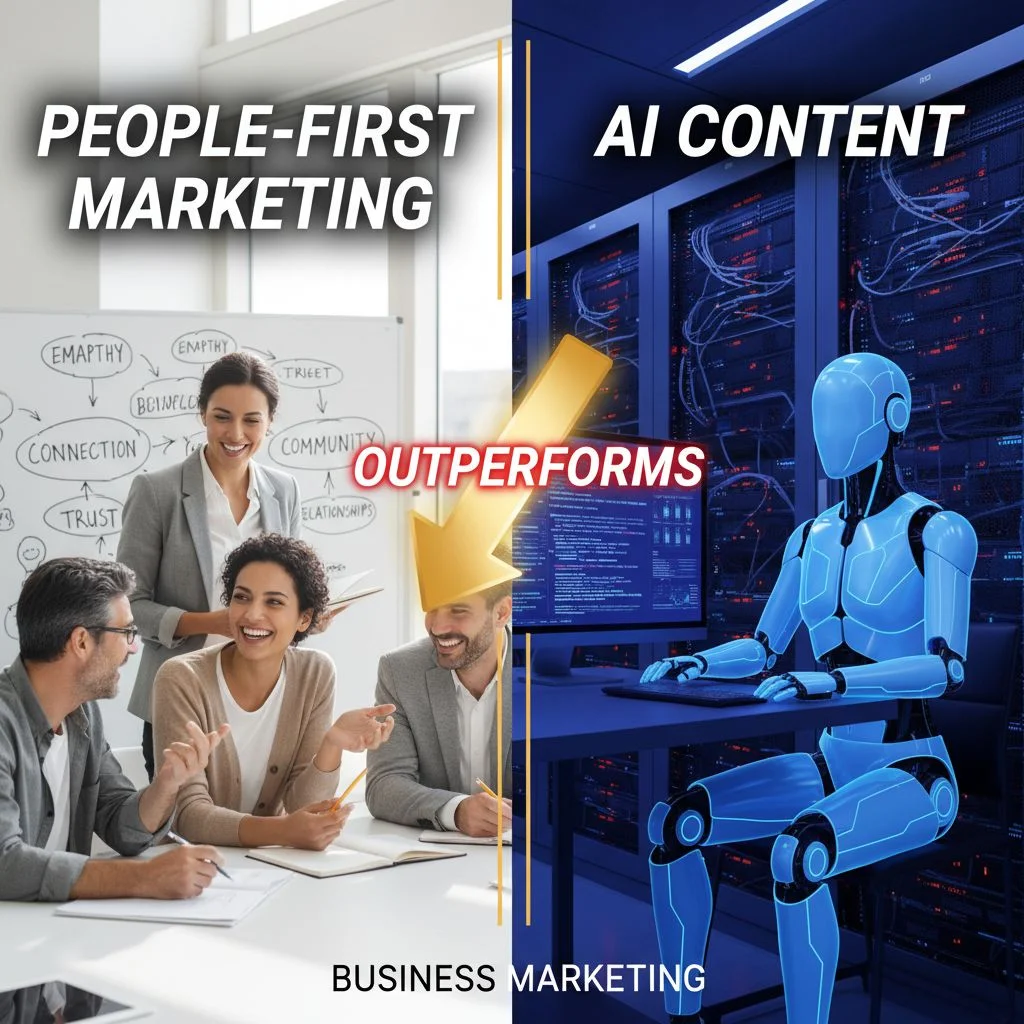
Fifty-seven percent of all web-based text is now estimated to be AI-generated or AI-translated. The result is a web flooded with accurate, well-structured, and completely interchangeable content — and an audience increasingly hungry for the one thing AI cannot produce: genuine human perspective, real professional experience, and the specific, messy, honest truth that only a human expert who has actually done the work can share. In 2026, the businesses winning are not the ones producing the most content. They are the ones whose content feels unmistakably human. This guide shows you exactly how to build that advantage — and why it earns more AI citations, more customer trust, and more revenue than any AI-generated alternative.
| Authentic, people-first marketing outperforms AI-generated content in 2026 because 81% of consumers say they must be able to trust a brand to buy from it, and 86–88% say authenticity matters when choosing who to support. As AI content floods the web — with an estimated 57% of online text now AI-generated or AI-translated — the scarcest and most valuable content is content that contains something AI cannot manufacture: genuine first-person expertise, real professional experience, original observations from direct practice, and the specific human voice that reflects real knowledge earned over time. This same authentic content also earns more AI citations — because AI search engines apply E-E-A-T evaluation (Experience, Expertise, Authoritativeness, Trustworthiness) and preferentially cite content that demonstrates genuine human expertise over content that synthesises existing information. |
What You Will Learn in This Guide
- Why 57% AI-generated web content is creating the biggest human authenticity opportunity in marketing history
- The data showing why consumers trust authentic content and distrust anonymous AI output
- The critical distinction: the backlash is not anti-AI — it is anti-anonymous
- The five dimensions of human authenticity that AI content cannot replicate
- How authentic human content earns more AI citations than polished AI-generated alternatives
- The “Creator CEO” advantage for small business owners — and how to build it
- Practical frameworks for documenting and sharing your genuine expertise without becoming a content creator
- The distribution strategy that amplifies authentic content beyond your existing audience
- A 30-day human authenticity marketing plan
The 57% Problem — and the Opportunity It Creates
When more than half of online text is already AI-generated or AI-translated, audiences begin to experience what some researchers call an internet quality crisis. People struggle to tell what is real. The volume of content has exploded. The average quality has collapsed. And the human response — entirely predictable in retrospect — is to place dramatically higher value on the rare content that feels unmistakably human.
AI has made content cheap. But it has made uniqueness and trust more valuable.
This is the paradox of the AI content era — and it is creating the most significant small business content advantage in years. The businesses that lean into genuine human expertise, real professional experience, and authentic first-person voice are becoming dramatically more visible precisely because they are increasingly rare. In a sea of interchangeable AI-generated advice, a single piece of content that contains something only a real professional with direct experience could know stands out with a signal strength that no algorithm-optimised article can match.
The data confirms this at every level. Eighty-one percent of consumers say they must be able to trust a brand to buy from it. Eighty-six to eighty-eight percent say authenticity matters when choosing who to support. Consumer data is clear that people still buy on trust, authenticity, and experience — not volume of posts.
And the AI citation data confirms it too. The content that AI search engines preferentially cite is content demonstrating genuine E-E-A-T — Experience, Expertise, Authoritativeness, and Trustworthiness. Eighty-nine percent of AI-only articles lack an identifiable expert author. AI content includes original research in only 4% of cases versus 38% for human content. Adding original statistics produces up to 40% improvement in AI citation rates.
Human authenticity is not just a marketing preference. It is an AI citation strategy. The same content that earns human trust earns AI recommendations — because both humans and AI systems have learnt to value the same things: genuine knowledge, specific experience, and verifiable expertise.
The Backlash Is Not Anti-AI — It Is Anti-Anonymous
This is the critical distinction that most marketing guides miss entirely — and getting it right changes how you approach every piece of content you produce.
The authenticity backlash in 2026 is not a rejection of AI tools. It is a rejection of anonymity — content that could have been written by anyone, based on nothing specific, reflecting no genuine expertise or perspective.
The backlash is not anti-AI. It is anti-anonymous. In a crowded content environment, authenticity has become a differentiator. Authenticity does not mean casual tone or personal anecdotes for their own sake.
The distinction matters enormously for small business owners. You do not need to choose between using AI tools and being authentic. You need to stop producing content that is anonymous — content with no named author, no specific professional experience, no original data, and no genuine perspective that reflects real knowledge. AI tools are not the enemy of authentic content. They are tools that help you produce authentic content more efficiently.
The businesses winning in 2026 use AI for research, drafting, and structure — then supply the human layer: the named expert authorship, the specific professional observations, the original data from direct practice, and the genuine voice that reflects someone who has actually done the work. Human-authored, experience-driven content performs better with audiences and with AI systems selecting sources. Generic AI-written content underperforms on both fronts.
The practical test for any piece of content you produce: could this have been written by anyone with access to the internet, or does it contain something specific that only you — with your professional experience, your client relationships, your direct market observations — could have written? If the answer is “anyone,” the content is anonymous. If the answer is “only me,” the content is authentic.
The Five Dimensions of Human Authenticity AI Cannot Replicate
Dimension 1: Direct Professional Experience
The most powerful form of authentic content is content that comes from having actually done the thing you are writing about. Not synthesised from research about the thing. Not assembled from what other people have said about the thing. Actually done it, observed the results, and formed a specific professional view based on what happened.
A business accountant who has personally worked through a specific regulatory change with fifty restaurant clients has observations no AI can generate — because those observations exist only in the mind of the professional who experienced them. A plumber who has diagnosed a particular type of pipe failure in a hundred Nashville homes has pattern recognition that cannot be found in any published source.
This direct professional experience is both your scarcest asset and your most citable content. When you document it specifically — “in my experience working with 63 Nashville restaurants over 14 years, the pattern I consistently observe is…” — you are producing content that AI systems cite because it contains information available nowhere else.
Practical applications:
- Weekly professional observation journal — spend 15 minutes each week writing down the most interesting or surprising thing you observed in your professional practice that week
- Pattern documentation — when you notice a pattern repeating across multiple clients or projects, write it down explicitly with specific numbers and examples
- Case study capture — for every significant client outcome (positive or negative), document the situation, the approach, and the result with specific measurable details
Dimension 2: Named Expert Voice With Verifiable Credentials
In many sectors, a credible specialist with a clear voice will outperform a brand account with ten times the followers. This is not a social media observation. It is an AI citation observation — because AI systems evaluate author credentials and named expertise as primary trust signals.
Anonymous content — published under a brand name or “by the editorial team” — earns fewer AI citations than equivalent content attributed to a named professional with verifiable credentials. This is not a subtle difference. Eighty-nine percent of AI-only articles lack an identifiable expert author. Named human authorship is one of the clearest signals that separates human expert content from AI-generated content in AI evaluation systems.
The “Creator CEO” trend — executives and business owners building recognisable personal brands around their specific expertise — is not just a social media strategy. It is an AI citation strategy. When your name appears consistently in your content, when that name is linked to verifiable professional credentials on LinkedIn, when AI systems can cross-reference your author bio with your professional associations and qualifications — your content earns more trust from both human readers and AI recommendation systems.
Practical applications:
- Add your full name, credentials, and years of experience to every piece of content you publish
- Link every author bio to a LinkedIn profile that explicitly confirms your professional qualifications
- Write occasional first-person opinion pieces that express your genuine professional view — even on topics where your view differs from the consensus
- Build a recognisable professional voice through consistent publication rather than sporadic anonymous posting
Dimension 3: Specific, Honest Opinions and Positions
Authentic marketing is not about casual tone or personal anecdotes for their own sake. It is about having and expressing specific professional positions — views you hold because of your direct experience, not because they represent the safe consensus.
AI-generated content is, by design, non-committal. It synthesises existing positions and tends toward balance and hedging because it is not able to take a genuine professional stance based on direct experience. “There are many approaches to this problem and the best one depends on your specific situation” is the natural output of a system that has never actually experienced the problem.
Human authenticity sounds like: “In my 14 years of working with Nashville restaurants, I have consistently seen that approach X fail for businesses under $500,000 in annual revenue — and here is specifically why.” That is a positioned statement that reflects direct professional experience. It is harder to produce than hedging. It is far more valuable to the reader. And it is exactly the kind of specific, verifiable claim that AI search engines cite preferentially.
The brands that win will be the ones that balance human authenticity with strategic use of technology and build communities through authentic connection. That authentic connection requires positions — real professional views that reflect genuine expertise, not careful statements designed to offend no one.
Practical applications:
- Identify the three professional positions you hold that differ from the consensus advice in your industry — and publish your reasoning
- Write an “unpopular opinion” piece once per quarter — a genuinely held professional view that your direct experience has led you to, even if it contradicts what most guides say
- In every FAQ answer you write, express a clear professional recommendation rather than “it depends on your situation”
Dimension 4: Real People, Real Faces, Real Stories
Brand growth in 2026 often starts with human faces, not brand marks. The shift from brand-first to people-first content is not a social media trend. It is a trust mechanism — and it applies to small businesses more powerfully than it does to large brands.
A large corporation that puts its CEO on a podcast is making a strategic communications decision. A small business owner who appears in their own content — explaining their process, demonstrating their craft, sharing their professional perspective in their own voice — is building a trust relationship that no enterprise communication budget can replicate.
The most credible thing a small business owner can do is be genuinely visible in their own content. Not polished. Not performed. Genuinely visible — showing the real work, the real team, the real decision-making process, and the real professional perspective.
This visibility does double duty: it builds the human trust that converts customers, and it provides the named expert authorship signals that earn AI citations. When your content is attributed to a recognisable human professional — someone with a face, a LinkedIn profile, a professional history — AI systems treat that attribution as a credibility signal that anonymous or brand-only content does not provide.
Practical applications:
- Include at least one piece of video content per month where you personally explain something from your professional experience — even a 90-second phone video
- Add a professional photo to every author bio
- Share behind-the-scenes content that shows the real work — the process, the problem-solving, the genuine complexity that clients often do not see
- Write occasional “what I learnt this week” professional reflections that document your ongoing growth and development
Dimension 5: Community and Dialogue, Not Broadcast
The most trusted content in 2026 is not produced in isolation and broadcast to a passive audience. It is produced in dialogue with a community — responding to real questions, addressing real challenges, and building genuine two-way relationships that create both content and trust simultaneously.
The businesses building the most durable marketing advantages are the ones treating their content as the beginning of a conversation rather than the end of a production process. Reddit contributions that generate genuine dialogue. YouTube videos that respond to viewer questions. Email newsletters that ask readers to share their specific challenge before offering advice. Every interaction that converts a broadcast into a dialogue is generating authentic engagement that AI-generated content cannot replicate.
This community dimension also feeds AI citation authority in a specific and documented way. Reddit is among the most-referenced domains by major AI systems. YouTube community discussions are indexed and cited. Email newsletter content that is forwarded, shared, and discussed generates the kind of organic third-party mention pattern that AI systems interpret as independently validated expertise.
How Authentic Human Content Earns More AI Citations
This is the connection most authenticity marketing guides completely miss — and it is one of the most powerful arguments for investing in genuine human content rather than AI-generated alternatives.
AI search engines are explicitly designed to evaluate E-E-A-T — Experience, Expertise, Authoritativeness, and Trustworthiness. These are not abstract quality descriptors. They are specific signals that AI evaluation systems are trained to detect — and they are precisely the signals that authentic human content produces naturally.
Human-authored, experience-driven content performs better with audiences and with AI systems selecting sources. Generic AI-written content underperforms on both fronts.
The specific human authenticity signals that earn AI citations:
Named expert authorship: AI systems that encounter content attributed to “John Smith, Licensed Master Electrician with 20 years of Nashville residential electrical experience” are significantly more likely to cite it than equivalent content published anonymously under a brand name. The attribution is verifiable. The expertise is specific. The citation is confident.
First-person experience markers: Phrases like “in our work with 63 Nashville restaurants,” “based on our experience diagnosing this problem in over 200 homes,” and “across our client base, the pattern we consistently observe is” are linguistic signals that AI evaluation systems associate with genuine professional experience. These markers are rare in AI-generated content and common in expert human content — making them positive differentiation signals.
Original data and observations: As established in the AI-proof content article in this series — adding original statistics produces up to 40% improvement in AI citation rates. The data that only genuine professional experience can produce is the data that earns the most citations. And genuine data requires a genuine human who has actually done the work.
Community validation: Authentic content that generates genuine community engagement — Reddit upvotes, YouTube comments, LinkedIn reactions from industry professionals — creates the social validation signals that AI systems use as secondary credibility indicators. AI-generated content, by definition, has no authentic community behind it.
The Creator CEO Framework for Small Business Owners
You do not need to become a content creator. You need to become a visible expert.
The Creator CEO trend — which brands the most effective personal brand builders as “Creator CEOs” — is often misunderstood as a requirement to produce high-volume social content. It is not. It is a recognition that the most trusted professional voice in any category is the specific, named, credentialled human being who has genuine expertise — and that making that expertise visible is a business strategy, not a vanity project.
For a small business owner, the Creator CEO framework means three specific things:
Consistent professional voice, not volume. Publish less but better. A piece of content that contains genuine professional insight published twice a month consistently outperforms daily generic posting in both human engagement and AI citation authority. Consistency is how brand trust compounds. Content calendars should prioritise coherent professional perspective over frequency.
Platform depth over platform breadth. Choose one or two platforms where your ideal customers spend time and build genuine depth on those — rather than shallow presence on every platform. A business accountant who is the most genuinely helpful expert in two Nashville business subreddits and publishes a substantive monthly LinkedIn article has more authentic human authority than a business with profiles on every platform and nothing worth reading on any of them.
Professional opinion, not just professional information. The content that builds genuine expert authority is not the content that explains what something is. It is the content that expresses what you specifically think about it — your professional assessment, your experience-based recommendation, your honest evaluation of approaches you have seen succeed and fail.
The Distribution Strategy That Amplifies Authentic Content
Authentic human content produced only on your own website reaches only the audience your website currently has. The businesses generating the most impact from their authentic expertise are the ones distributing it through channels that reach audiences beyond their existing followers.
The most effective distribution channels for authentic human content — specifically because they amplify its AI citation value alongside its human reach:
Community platforms that AI draws from: Contributing your genuine professional expertise to the Reddit communities and industry forums that AI systems already reference transforms your authentic content into AI training data simultaneously with community trust building. A substantive, expert, experience-based answer in a subreddit that Perplexity and ChatGPT draw from is reaching two audiences at once — the human community members and the AI systems that cite community discussions as reference material.
Industry publications that value genuine expertise: Contributing expert articles to industry publications and local news outlets provides the independent editorial validation that converts authentic expertise into trusted AI citation source material. The editorial decision to publish your contributed article is itself a quality signal — one that AI systems recognise as credibility validation.
Multi-publication content distribution networks: When your most genuinely expert content — the content that contains your original professional observations, your specific data, your first-person experience — is distributed across hundreds of legitimate editorial publications simultaneously, the AI citation authority compounds rapidly. Each new editorial mention of your expert perspective adds to the pattern of independent confirmation that AI systems interpret as verified expertise. The same content that earns human trust from readers of real newspapers and magazines also feeds the AI citation systems that are increasingly determining which businesses get recommended.
AI news distribution services: For expert content that addresses timely professional topics — regulatory changes, market developments, industry trends you have directly observed — reaching journalists and editors through specialised distribution services designed for AI-era news visibility can place your authentic expert perspective in front of publications that generate AI citations for news-adjacent queries.
The combination of genuine human expertise and strategic multi-channel distribution is the complete content strategy for 2026: authentic enough to earn human trust, distributed widely enough to earn AI citations, and attributed clearly enough for both human readers and AI systems to recognise the expert behind it.
The 30-Day Human Authenticity Marketing Plan
Week 1: Define Your Expert Voice
Write your professional positioning statement — one specific paragraph that describes what you genuinely know, what direct experience you have that is unique, and what professional positions you hold that reflect that experience. This is the foundation of your authentic marketing voice.
Identify your three most genuinely held professional positions — views you hold based on direct experience that differ from the generic advice in your category. These positions are your most citable content opportunities.
Update every piece of content on your website to include a named author bio with your specific credentials. Add your professional photo. Link to your LinkedIn profile.
Week 2: Document Your First Authentic Content Pieces
Write your first genuinely expert piece — a professional observation based on something you directly observed in your practice this month. Not a summary of what others have said. Something you specifically know from having done the work.
Record your first short video — a 90-second phone video explaining one specific professional insight in your own voice. Upload it to YouTube with a question-based title. Write a description that summarises the direct answer.
Make your first genuine community contribution — a 300-word expert answer to a specific question in the most relevant subreddit for your category. Based on direct professional experience. Not promotional.
Week 3: Build Your Distribution Strategy
Identify the two or three community platforms where your ideal customers discuss problems you can genuinely help with. Commit to two to three substantive contributions per week — not promotional, genuinely helpful.
Write a pitch for one contributed expert article — a specific professional topic you can address from direct experience, submitted to an industry publication or local business publication.
Evaluate whether multi-publication content distribution is the right acceleration strategy for your most expert content. The ROI calculation: authentic expert content distributed across hundreds of real editorial publications generates both AI citation authority and human trust credentials simultaneously — and the combination produces compounding returns that individual publication cannot match.
Week 4: Measure and Iterate
Run your AI citation test for your authentic content pieces. Do your expert observations appear when AI tools answer questions in your category? Do your community contributions appear as cited sources in Perplexity results? Does your business description in AI responses reflect your specific expertise rather than generic category language?
Check your branded search volume trend. Rising branded searches following the publication of genuinely expert content — the kind of content people share with colleagues and reference in their own conversations — is the most reliable indicator that authentic human marketing is generating awareness beyond your direct audience.
Plan your next authentic content piece based on the professional observation you are most likely to make in the coming month. The businesses that make authentic content production a consistent professional habit — rather than a sporadic marketing campaign — build the compounding expert authority that AI systems learn to trust and cite consistently.
Frequently Asked Questions
If authentic content is so valuable, why is most business content still generic?
Because generic content is faster and easier to produce — particularly with AI tools that can generate a serviceable article in minutes. The businesses choosing authenticity over speed are making a long-term strategic bet: that their specific professional expertise, documented consistently, will compound into a durable competitive advantage that generic content cannot match. That bet is increasingly confirmed by both conversion data and AI citation research.
Do I need to share personal information to be authentic?
No. Professional authenticity is not personal disclosure. It is professional disclosure — sharing your specific expertise, your professional observations, your genuine professional positions, and your real professional experience. You can be completely authentic about your professional knowledge without sharing anything personal. The personal anecdote is one form of authentic content. The specific professional case study is another. The original industry observation is another. Choose the form that suits your personality and professional culture.
Can I be authentic and still use AI tools?
Absolutely — and the most effective content producers in 2026 do exactly this. AI tools handle research, structure, and drafting. You supply the expert layer: the named authorship, the original professional data, the first-person observations, the specific case study details, and the genuine professional position. The combination — AI efficiency plus human authority — produces content that is both faster to create and more valuable than either alone.
How do I find my authentic professional voice if I am not a natural writer?
Speak, then transcribe. Record yourself answering the five questions your customers ask most frequently — as if you were explaining to a colleague, not writing for publication. Transcribe the recordings and edit for clarity. The spoken voice is naturally more authentic and more specific than the written voice for most non-writers — and the authentic spoken perspective is exactly what AI content lacks.
Does authentic marketing work for service businesses in unsexy industries?
Especially in unsexy industries. The more technical, the more specialist, the more apparently uninteresting the subject — the more valuable a genuine expert voice becomes. A plumber who writes specifically and honestly about the most common pipe failure patterns in Nashville homes built between 1960 and 1980, with real data from real jobs, in their own professional voice — has essentially no competition in that specific territory. The AI-generated content in that space is generic. Their authentic expert content is unique and permanently citable.
The Bottom Line
AI has made content cheap. It has made human authenticity more valuable than at any point in the history of digital marketing.
Fifty-seven percent of online text is AI-generated. Eighty-one percent of consumers require trust before buying. Eighty-six to eighty-eight percent say authenticity determines who they choose to support. And AI search engines — the recommendation systems your customers increasingly rely on — explicitly prioritise the experience, expertise, authoritativeness, and trustworthiness signals that only genuine human content naturally produces.
The human advantage is real. It is measurable. It is available to any small business owner willing to document their genuine professional experience, publish it under their real name, express their genuine professional positions, and distribute it through channels that amplify authentic expertise to audiences beyond their existing reach.
You do not need to produce more content. You need to produce content that only you could have written.
Start with your professional observation from this week. Write it down specifically. Attribute it to your real name with your real credentials. Publish it. Share it in the community where your customers are discussing exactly that challenge.
Then do it again next week.
That is the human advantage. And it compounds.
Published by Business Startup Support — practical strategies for founders, startups, and small business owners who want to grow smarter. Visit businessstartupsupport.com
Once you have built your authentic expert content, distributing it through multi-publication content networks and AI news distribution services amplifies its reach to audiences and AI citation pools far beyond what your own channels can access. Your genuine professional expertise — distributed across hundreds of legitimate editorial publications — generates the independent confirmation pattern that both human readers and AI systems interpret as verified authority. Visit businessstartupsupport.com to learn more.
Complete Series: The Business Startup Support AEO, SEO, and GEO Guide
- SEO vs AEO: What’s the Difference and Which One Should Your Business Focus On in 2026?
- How Do I Get My Business Recommended by ChatGPT and Google AI Overviews?
- What Kind of Content Makes AI Search Engines Recommend My Business Over Competitors?
- Does My Local Business Need AEO, or Is Google Maps and Local SEO Enough?
- Why Your Ad Spend Isn’t Training AI to Recommend You
- The 5-Channel Visibility Framework for Business Owners in 2026
- What Is GEO (Generative Engine Optimization) and How Is It Different From SEO and AEO?
- How to Write a Perfect FAQ Page That Gets Cited by AI Search Engines
- Why Your Business Is Invisible in AI Search Results — And the Exact Steps to Fix It in 30 Days
- Your Competitors Are Being Recommended by AI Search Engines — Here’s How to Catch Up and Overtake Them
- How to Get Your Business Found, Trusted, and Chosen by AI Search Engines
- Stop Wasting Your Marketing Budget: How to Get AI Search Engines to Recommend Your Business for Free
- The Small Business Owner’s Guide to Earning AI Search Recommendations — Without a Marketing Team or Big Budget
- Why 85% of What Your Customers Ask AI Has Nothing to Do With Your Keywords
- How to Use YouTube and Reddit to Get Your Business Recommended by AI Search Engines
- How to Build Topical Authority That Makes AI Search Engines Treat Your Business as the Go-To Expert
- The AI Search Visibility Audit: How to Know Exactly Where Your Business Stands — And Fix It Fast
- What Is Agentic AI and Why It Will Change How Customers Find and Buy From Your Business by 2028
- Why Your Search Traffic Is Falling Even Though You Are Doing Everything Right
- How to Build a Brand That AI Search Engines Trust, Recommend, and Cannot Ignore
- Voice Search and AI Assistants: How to Make Sure Your Business Gets Recommended When Customers Ask Out Loud
- The AI-Proof Content Strategy: How to Create Content That Outperforms AI-Generated Articles and Earns Citations
- How to Turn AI Search Visibility Into Paying Customers: The Conversion Strategy for the AI Era
- Search Everywhere Optimization: The Strategy That Replaces SEO as the Primary Growth Channel for Small Businesses
- Why Getting Featured in the News Is Now One of the Fastest Ways to Get Recommended by AI Search
- How to Use Hyper-Personalisation and First-Party Data to Win More Customers in the AI Era
Author

Citizen Kim: The Woman Who Created the Future
$31.49 (as of October 27, 2026 17:59 GMT +00:00 – More infoProduct prices and availability are accurate as of the date/time indicated and are subject to change. Any price and availability information displayed on [relevant Amazon Site(s), as applicable] at the time of purchase will apply to the purchase of this product.)
INFLUENCING THE MASSES: The Psychological Techniques a Handful of People Use to Steer Billions of Minds
$19.98 (as of October 27, 2026 17:59 GMT +00:00 – More infoProduct prices and availability are accurate as of the date/time indicated and are subject to change. Any price and availability information displayed on [relevant Amazon Site(s), as applicable] at the time of purchase will apply to the purchase of this product.)
Get to Work: Seeing Your Daily Grind as God’s Good Gift
$17.98 (as of October 27, 2026 17:59 GMT +00:00 – More infoProduct prices and availability are accurate as of the date/time indicated and are subject to change. Any price and availability information displayed on [relevant Amazon Site(s), as applicable] at the time of purchase will apply to the purchase of this product.)
The Thinking Machine: Jensen Huang, Nvidia, and the World’s Most Coveted Microchip
$1.99 (as of October 27, 2026 17:59 GMT +00:00 – More infoProduct prices and availability are accurate as of the date/time indicated and are subject to change. Any price and availability information displayed on [relevant Amazon Site(s), as applicable] at the time of purchase will apply to the purchase of this product.)


Leave a Reply