
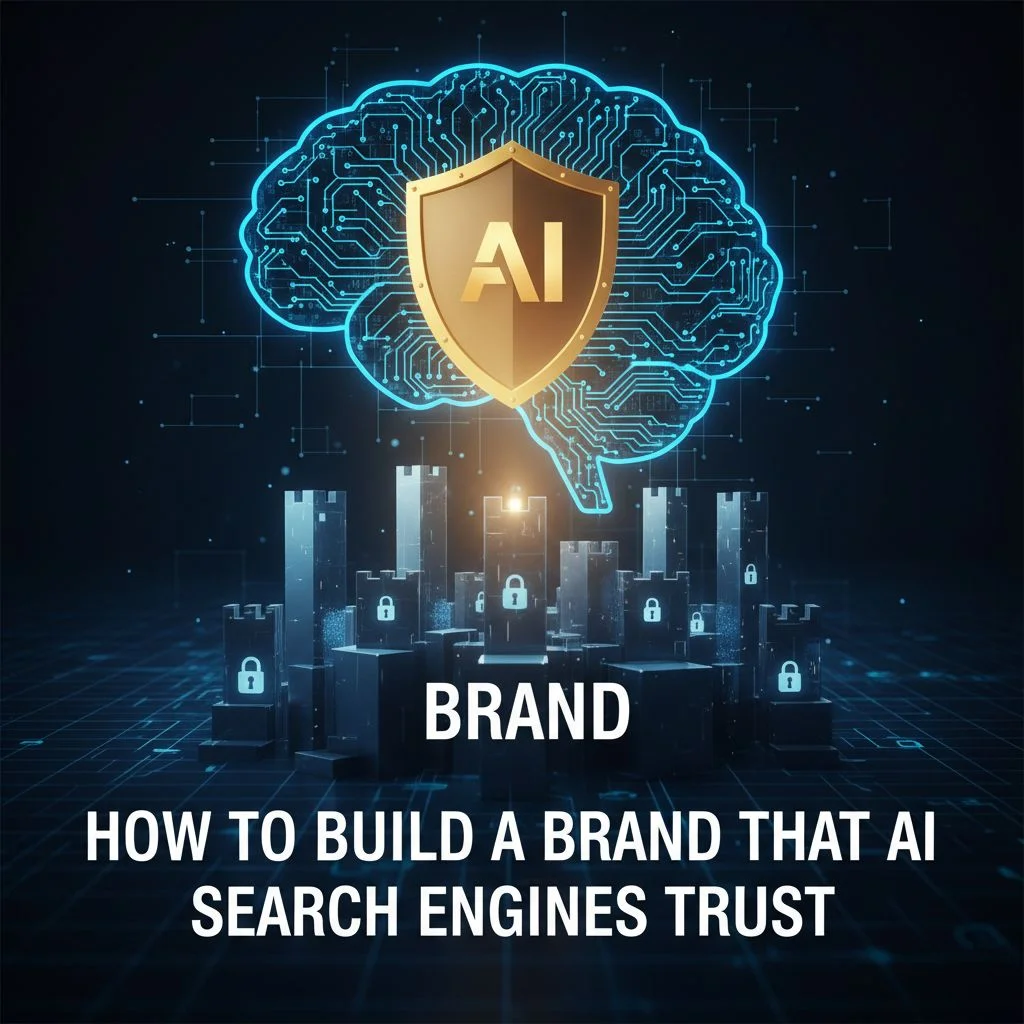
AI search engines trust brands the same way people trust experts. How to Build a Brand That AI Search Engines Trust — through repeated, consistent, independent confirmation across multiple credible sources. A business that only talks about itself on its own website is easy for AI to dismiss. A business that is consistently mentioned, quoted, cited, and referenced across hundreds of trusted independent sources becomes, in AI terms, a verified entity — and verified entities get recommended. This guide gives you the complete framework for building that brand authority systematically, whether you are starting from zero or accelerating an existing reputation.
| To build a brand that AI search engines trust and recommend, you need to work across three fronts simultaneously: technical signals (schema markup, entity consistency, structured data that helps AI systems verify and categorise your brand), content authority (deep, specific, expert-attributed content that demonstrates genuine knowledge AI cannot replicate), and external validation (independent mentions in trusted publications, review platforms, community forums, and news media that confirm your authority to AI systems from sources they already trust). AI systems learn credibility the same way people do — by noticing repeated signals of trust across the web. When your expertise gets mentioned in different, relevant contexts, those signals compound into recommendation authority that your competitors cannot easily replicate or buy. |
What You Will Learn in This Guide
- Why brand authority for AI is fundamentally different from brand awareness for humans — and the specific signals that matter
- The three-front framework that builds AI brand trust simultaneously across technical, content, and external validation channels
- The “as seen on” credibility effect — why media coverage converts and how it feeds AI citation systems
- Why unlinked brand mentions matter as much as backlinks for AI trust — and how to earn them at scale
- The human authenticity advantage — why original thought and genuine expertise are becoming the most valuable brand assets in the AI era
- How to build a brand knowledge base that AI systems draw from consistently
- The mass media distribution strategy that accelerates AI brand authority from months to weeks
- A 90-day brand authority build plan with clear milestones
The Fundamental Difference Between Brand Awareness and Brand Authority
Most small businesses understand brand awareness — the degree to which potential customers know your business exists. Brand awareness is built through advertising, social media, word of mouth, and consistent visual identity. It lives primarily in human memory.
Brand authority is different. It is the degree to which your business is recognised as a credible, expert source within your category — not just by customers, but by other publishers, independent platforms, and increasingly by AI search engines. Brand authority is not built in human memory alone. It is built in the web’s collective memory — the vast network of publications, reviews, discussions, and references that AI systems draw from when deciding who to recommend.
High brand authority means AI engines like ChatGPT and Perplexity proactively recommend you when a potential customer asks a relevant question — without you paying for placement. It means your business appears in AI answers not because you paid to be there but because the wider web has confirmed, repeatedly and independently, that you are a credible authority in your space.
The distinction matters because the strategies that build brand awareness and brand authority are different — and many businesses are investing heavily in the former while almost ignoring the latter.
Running social media ads builds brand awareness. It does not build brand authority. Publishing billboard campaigns creates visibility. It does not create AI citation signals. A viral TikTok video can generate millions of impressions. It can generate zero AI recommendation authority.
Brand authority for AI is built through three specific channels: technical signals that help AI verify your identity and expertise, content that demonstrates genuine knowledge, and external validation from sources AI already trusts. Every investment in these three channels compounds over time in ways that advertising spend cannot replicate.
Why AI Systems Trust Some Brands and Not Others
To build a brand AI trusts, you need to understand how AI systems actually assess trustworthiness — because it is more specific and more learnable than most business owners realise.
AI models assess not just whether your brand is trustworthy in general, but whether it is specifically trustworthy in the domain of the question being asked. This is topical brand authority — and it is built through content depth, consistency, and cross-platform confirmation.
AI systems learn credibility the same way people do: by noticing repeated signals of trust across the web. When your expertise gets mentioned in different, relevant contexts, those signals compound.
Think about how you personally come to trust an expert. You might hear them mentioned by a colleague. Then see them quoted in a respected publication. Then find their advice confirmed by an independent review. Then notice they are referenced in an industry forum discussion. No single signal convinced you. It was the pattern — consistent, independent, authoritative mentions across multiple trusted contexts.
AI systems build brand trust through exactly the same pattern recognition. A business mentioned once on its own website is not trusted. A business mentioned consistently across hundreds of independent, credible sources — news publications, review platforms, community discussions, industry directories, podcast transcripts, and editorial features — becomes a verified entity that AI systems can recommend with confidence.
There are three specific signals AI systems use to evaluate brand trustworthiness:
Signal 1: Entity consistency. Does every source describe your business the same way? Is your business name, service description, and contact information identical across your website, your Google Business Profile, your LinkedIn, every directory listing, and every external mention? Inconsistencies register as uncertainty — and uncertain entities are not confidently recommended.
Signal 2: Citation density and source quality. How many independent sources mention your brand? How trusted are those sources in AI training data? A business mentioned by fifty independent editorial sources with high domain authority is significantly more trustworthy than a business with a thousand social media posts no AI system references.
Signal 3: Unlinked brand mentions. This is the insight most businesses miss entirely. Unlinked brand mentions — where a trusted publication, forum, or source refers to your brand by name without including a hyperlink — contribute to AI trust signals because AI models process text, not just link graphs. When trusted publications consistently mention your brand name in contextually relevant discussions, the AI registers those co-occurrences and builds confidence in your brand’s relevance to that topic.
This is why mass media coverage — even without backlinks to your website — builds AI citation authority. A regional newspaper article that mentions your business name in a story about your industry generates an AI trust signal whether or not it links to your site. Multiply that across 500 publications and the trust signal becomes one of the most powerful AI authority builders available.
Front 1: Technical Signals — Help AI Verify Who You Are
The technical front of brand authority building is about making your business identity machine-readable and verifiable. It is the foundation — without it, even the strongest content and external validation produces reduced AI citation returns.
Build a Complete Entity Profile
Your entity profile is the sum of all structured data that tells AI systems exactly what your business is. The most important components:
Master entity description: Write two to three sentences that precisely and specifically describe your business — what you do, who you serve, where you operate, and what makes you credible. Use this description verbatim across every platform. Not paraphrased — identical. This consistency is what allows AI systems to confidently characterise your brand across sources.
LocalBusiness schema on your homepage: This explicitly tells AI systems your business name, address, phone number, service area, opening hours, and business type. It is the structured data equivalent of registering your identity with every AI system simultaneously.
FAQPage schema on every Q&A section: Marks up your question-and-answer content explicitly so AI can extract clean citation units from it.
Article schema on every blog post and guide: Signals that your content is authoritative editorial material — not marketing copy.
llms.txt file: A newer technical development gaining adoption in 2026, this is a text file placed in your website’s root directory that specifically tells AI systems which content to reference and how to characterise your expertise. It is the AI equivalent of a sitemap — a direct communication channel between your website and the AI systems you want to earn citations from.
Implement Consistent NAP Everywhere
Name, Address, Phone number — identical across every platform. This is not just a local SEO tactic. It is an entity verification signal that AI systems use to confirm your business is a real, active, consistently represented entity. Any inconsistency creates a trust gap that reduces recommendation eligibility.
Create a Brand Knowledge Base Page
A brand knowledge base is a dedicated page on your website — typically called “About,” “Brand Resources,” or “Press” — that serves as the definitive reference for everything AI systems might want to know about your business. It should include:
- Your master entity description
- Your founding date, location, and service areas
- Your team’s credentials and qualifications — explicitly stated
- Key statistics about your work (number of clients served, years in business, notable outcomes)
- Your media mentions and press coverage — with links
- Frequently cited statistics or data points your business has produced
- A clear statement of what you specialise in and who you serve
This page gives AI systems a single, authoritative first-party source to draw from when characterising your business — reducing the risk of inaccurate AI descriptions and increasing the consistency of your AI mentions.
Front 2: Content Authority — Build Knowledge AI Cannot Replicate
Content authority for AI is not about volume. It is about producing the specific type of content that AI systems prefer to cite rather than summarise — content so specific, so deeply expert, and so rich with original data that AI cannot generate it from its training data alone.
The Human Authenticity Advantage
There is a concept emerging in 2026 marketing circles called the “owned line” — original thought, original data, and genuine first-person expertise as the new competitive moat in an era of AI-generated content.
AI-generated content has flooded the web. Much of it is accurate, well-structured, and useful. But it is inherently derivative — it synthesises what already exists rather than adding genuinely new knowledge. The content that AI systems preferentially cite is content that contains something they cannot reproduce: your specific professional experience, your proprietary data, your direct observations from years of practice in your field.
A business accountant who publishes “Based on our work with 63 Nashville restaurants over 14 years, here are the three tax mistakes we see 80% of them make in their first year of operation” has produced content that no AI system can generate from training data — because the data does not exist anywhere else. That content is uniquely citable. It becomes a primary source, not a secondary one.
The human authenticity advantage is real and growing. As AI-generated content saturates the web, the scarcest and most valuable content becomes content that only a human expert with genuine lived experience could produce. Building your brand authority means systematically documenting and publishing that expertise.
Practical content authority actions:
Publish proprietary research annually. Survey your customers or clients. Document your operational data. Analyse trends you observe in your practice. Publish your findings with methodology. Even a single original statistic — “78% of the small business owners we surveyed had never tested whether their business appears in AI search results” — becomes a permanently citable reference that compounds your citation authority every time another source references it.
Document case studies with specific numbers. Every client success story contains information that exists nowhere else — the specific situation, the specific intervention, the specific measurable outcome. “We helped a Nashville restaurant owner reduce their quarterly tax bill by $14,000 by restructuring how they categorised equipment leases” is uniquely citable. Generic claims about “helping clients save money” are not.
Write expert analysis, not content summaries. The web is full of articles that summarise what other articles said. AI systems already know all of that. What they cannot replicate is your professional analysis — your assessment of what a trend means, your prediction of where an industry is heading, your critique of a common practice in your field. This is the “owned line” that builds brand authority no competitor can simply copy.
Attribute every piece of content to a named expert. Anonymous content earns fewer AI citations than content attributed to a named professional with verifiable credentials. Add complete author bios — name, qualifications, years of experience, professional association memberships — to every article and guide on your website. Link to a LinkedIn profile that confirms the same credentials. AI systems use this attribution to assess whether content comes from genuine expertise or generic generation.
Front 3: External Validation — Get Trusted Sources to Confirm You
This is the front where most businesses under-invest — and where the largest AI authority gains are available.
AI systems trust what independent sources say about you more than what your own website says. This is not a flaw in AI design. It is the same logic that makes peer review more credible than self-assessment. A business that is consistently mentioned, quoted, and referenced by sources AI already trusts becomes, through that pattern of external confirmation, a trusted entity itself.
The sources that carry the most AI citation weight are:
High-authority news publications (DA 45+): National and regional newspapers, TV news affiliates, and established magazines are among the most trusted sources in AI training data. A mention in The Providence Journal (DA 80), Reno Gazette-Journal (DA 76), or Wisconsin State Journal (DA 86) carries authority signals that most websites spend years trying to build through backlinks alone. These publications have real staff, real editorial standards, and real audiences — qualities AI systems use to evaluate source credibility.
Industry publications and trade media: Mentions in respected industry publications establish topical authority specifically — AI systems learn that your brand is trusted specifically within your professional domain, not just generally.
Community platforms AI already draws from: Reddit, Quora, and LinkedIn are among the most-referenced community sources by major AI systems. Genuine contributions to relevant communities build citation authority in the sources AI checks first.
Review platforms with verified reviews: Google Reviews, Trustpilot, and sector-specific review sites provide independently validated social proof that AI systems weight as trust signals.
Podcast transcripts: Indexed by AI systems and counted as attributed expert content from third-party sources. An appearance on a respected industry podcast generates AI-citable material on a trusted independent platform.
The Mass Media Distribution Strategy
The most significant acceleration available for external validation authority is mass media distribution — getting your brand content published across hundreds of legitimate, high-authority editorial sites simultaneously.
When your brand is published across 500+ real editorial publications — newspapers, TV news affiliates, and magazines with combined audiences in the hundreds of millions — something specific happens in AI systems. They begin encountering your brand name in the same contexts, across hundreds of trusted independent sources, describing the same expertise consistently. That pattern of independent confirmation is precisely what AI systems interpret as verified brand authority.
The effect is cumulative and compounding. Each new editorial mention adds to the pattern. Each high-DA site that references your business name increases the confidence score AI assigns to your brand. Over time, this pattern builds a brand authority position that is genuinely difficult for competitors to replicate — because they cannot fake the independent editorial confirmation that hundreds of legitimate news sources provide.
This is why services that distribute your content across legitimate high-authority news networks are generating measurable AI visibility improvements for businesses using them. The newspapers, TV news affiliates, and magazines in these networks are not content farms — they are established editorial brands with real staff, real audiences, and domain authority scores averaging 45 to 86. They are precisely the sources that AI systems like ChatGPT and Google already treat as primary references.
For businesses serious about building brand authority that AI cannot ignore, a single campaign across 500+ publications of this calibre produces more citation signal than most businesses generate through years of individual media outreach. And the “As Seen On NBC, ABC, CBS, Fox News” credibility that comes with publication across these networks does double duty — it feeds AI citation systems and it converts human visitors at higher rates, because mainstream media proof converts. Businesses using media trust badges in their marketing consistently see improvements across conversion rates, ad performance, and client close rates.
Earning Unlinked Brand Mentions at Scale
The insight that AI models process text rather than just link graphs changes the economics of brand authority building. You do not need every mention of your brand to include a backlink to benefit from it. Every time a trusted source mentions your business name in a contextually relevant discussion — whether linked or not — AI systems register that co-occurrence and strengthen their association between your brand and its claimed expertise.
This means that:
- A newspaper article mentioning your business name builds AI authority with or without a backlink
- A Reddit thread where a community member recommends your business builds authority whether or not they link to your site
- A podcast host mentioning your brand name builds authority from the transcript alone
The practical implication: pursue mentions in trusted sources, not just backlinks from trusted sources. A business that earns 500 unlinked mentions across high-authority publications has built significant AI citation authority even without a single new referring domain.
The “As Seen On” Conversion Effect
There is a conversion dimension to brand authority building that most guides treat as a nice-to-have bonus. In practice, it is one of the most important business outcomes of the strategy.
When your brand has been published across mainstream news outlets and you can legitimately display “As Seen On NBC, ABC, CBS, Fox News” in your marketing materials — on your website, your product pages, your social media profiles, your proposals and presentations — something measurable happens to conversion rates.
Mainstream media proof converts. The psychological mechanism is trust transfer — customers who trust NBC, ABC, and Fox News extend some of that trust to a business that has been featured on those platforms. They arrive with a higher baseline of credibility and a lower threshold of scepticism. The sales conversation starts from a stronger position.
This is the same mechanism that has made editorial PR valuable for decades — but in the AI era, it has a second benefit that did not exist before. Every publication that carries your brand’s story is a signal in AI training data. The “As Seen On” credibility that converts human visitors and the AI citation authority that generates AI recommendations are built from the same editorial publications simultaneously.
One investment — getting your content published across legitimate, high-authority editorial networks — produces two distinct returns: human trust conversion and AI citation authority. That dual return is why businesses that understand both systems are treating media distribution as a priority investment rather than a marketing afterthought.
The 90-Day Brand Authority Build Plan
Days 1–15: Technical Foundation
Write your master entity description. Update every platform to use it consistently. Complete your Google Business Profile fully. Implement LocalBusiness, FAQPage, and Article schema across your key pages. Validate everything at search.google.com/test/rich-results. Create your brand knowledge base page — the definitive first-party reference for everything AI systems need to know about your business.
Days 16–30: Content Authority
Audit your existing content for expert attribution — add named author bios with credentials to every page that lacks them. Identify the one piece of original research you can produce from your own professional data (a customer survey, a case study with specific numbers, an analysis of patterns you observe in your practice). Publish it with full methodology and your name prominently attributed.
Rewrite the first sentence of your five most important pages to lead with a direct, complete answer to the question each page is about. Add a 5-question FAQ section to each, with FAQPage schema.
Days 31–60: External Validation — First Wave
List your business in your top five industry-specific directories using your master entity description verbatim. Launch your review collection system — ask every satisfied customer within 24 hours of work completion. Make your first substantive contributions to the two or three Reddit communities most relevant to your category. Join and contribute to relevant LinkedIn groups and professional forums.
Identify the external validation opportunity with the most immediate impact for your business type — a news distribution campaign, a guest article pitch to an industry publication, or a podcast appearance — and initiate it this week.
Days 61–90: Media Authority and Measurement
If you have not already launched a media distribution campaign, this is the highest-leverage action in the 90-day plan. Getting your brand published across hundreds of legitimate, high-authority editorial sites generates the citation density that individual efforts cannot match in the same timeframe. The publications in professional distribution networks — with DA scores averaging 45 to 86 — are precisely the external validation sources AI systems weight most heavily.
Run your first full brand authority audit. Ask ChatGPT and Perplexity: “What can you tell me about [your business name]?” and “Who are the most trusted experts in [your specific topic] in [your area]?” Document the responses. Note whether your business is named, how it is described, and whether the description matches your master entity description. Any inaccuracies indicate source data that needs correcting. Any absences indicate citation gaps to fill.
Set your monthly maintenance rhythm: monthly AI query test (20 queries across three platforms), monthly branded search volume check in Google Search Console, monthly review of new citation opportunities, quarterly content refresh for all key pages, and quarterly brand knowledge base update.
Frequently Asked Questions
How long before AI systems begin recommending my brand consistently?
The timeline depends on your starting authority level and how aggressively you build across all three fronts. Technical fixes (schema, entity consistency) begin affecting AI responses within days to weeks of being indexed. Original expert content earns first citations within four to eight weeks of publication. External validation from media distribution and community contributions builds citation density over 60 to 90 days of consistent effort. Full, consistent AI brand recommendation authority typically requires three to six months of sustained three-front investment — but early signals (first AI mentions, rising branded search volume) typically appear within the first 30 to 60 days.
Is it better to focus on one front at a time or all three simultaneously?
Simultaneously — but not equally. The technical front (entity consistency, schema markup) should be addressed first and completely, because it is the prerequisite for everything else. A technically inconsistent brand gets reduced benefit from excellent content and strong external validation. Once the technical foundation is solid, invest in content authority and external validation in parallel — they reinforce each other, with content giving external sources something credible to reference and external validation teaching AI systems to treat your content as authoritative.
Do I need to be featured in national media to build AI brand authority?
No — and regional and local media often carries more targeted authority for local businesses than national coverage. A mention in your regional newspaper (DA 65–80) about a local business topic is a high-quality AI trust signal for local queries. The key is source credibility (domain authority, real editorial standards, real audience) and relevance to your category — not the geographic scale of the publication.
What is the fastest single action I can take to improve my brand’s AI citation authority?
Fix your entity consistency today. Google your business name and audit every listing for NAP consistency and description accuracy. Then update every platform with your master entity description used verbatim. This single action — completing in two to three hours at zero cost — removes the trust gaps that suppress AI recommendation eligibility for businesses that otherwise have good content and some external presence. It is the technical prerequisite that amplifies every other investment.
How does news media distribution specifically improve AI citations?
When your content is published across hundreds of legitimate, high-authority editorial sites — newspapers, TV news affiliates, and magazines with real staff and real audiences — AI systems encounter your brand name and expertise description consistently across sources they already treat as trusted references. That pattern of independent editorial confirmation is one of the strongest AI trust signals available. The publications in professional distribution networks have domain authority scores averaging 45 and reaching up to 86 — the same publications whose content appears consistently in AI Overviews and AI-generated answers. Getting your brand into those publications puts you in the citation pool AI systems already draw from.
The Bottom Line
Building a brand that AI search engines trust, recommend, and cannot ignore is not a single tactic. It is a system — technical signals that verify your identity, content authority that demonstrates genuine expertise, and external validation that confirms your credibility through the sources AI already trusts.
AI systems learn credibility the same way people do — through repeated, consistent, independent confirmation across multiple trusted contexts. The businesses that earn consistent AI recommendations are not the ones with the biggest advertising budgets. They are the ones that have built the deepest pattern of independent, credible confirmation across the web.
That pattern is buildable. It is systematic. And it compounds over time in ways that no advertising spend can replicate — because advertising buys visibility, while authority is earned.
Start with your entity consistency today. Build your content authority this month. Launch your external validation strategy — whether through individual outreach, community contributions, or mass media distribution — before the end of this quarter.
The brands AI cannot ignore are being built right now. The window to build yours before your competitors realise how the game has changed is still open.
Build the brand that AI recommends. Then let it work for you.
Published by Business Startup Support — practical strategies for founders, startups, and small business owners who want to grow smarter. Visit businessstartupsupport.com
Want to accelerate your brand’s AI citation authority? Primetime Publishing distributes your content across 500+ legitimate TV news, newspaper, and magazine sites — with domain authority averaging DA 45 and reaching DA 86. These are the exact publications AI systems treat as trusted editorial references. Visit businessstartupsupport.com to learn more.
Complete Series: The Business Startup Support AEO, SEO, and GEO Guide
- SEO vs AEO: What’s the Difference and Which One Should Your Business Focus On in 2026?
- How Do I Get My Business Recommended by ChatGPT and Google AI Overviews?
- What Kind of Content Makes AI Search Engines Recommend My Business Over Competitors?
- Does My Local Business Need AEO, or Is Google Maps and Local SEO Enough?
- Why Your Ad Spend Isn’t Training AI to Recommend You
- The 5-Channel Visibility Framework for Business Owners in 2026
- What Is GEO (Generative Engine Optimization) and How Is It Different From SEO and AEO?
- How to Write a Perfect FAQ Page That Gets Cited by AI Search Engines
- Why Your Business Is Invisible in AI Search Results — And the Exact Steps to Fix It in 30 Days
- Your Competitors Are Being Recommended by AI Search Engines — Here’s How to Catch Up and Overtake Them
- How to Get Your Business Found, Trusted, and Chosen by AI Search Engines
- Stop Wasting Your Marketing Budget: How to Get AI Search Engines to Recommend Your Business for Free
- The Small Business Owner’s Guide to Earning AI Search Recommendations — Without a Marketing Team or Big Budget
- Why 85% of What Your Customers Ask AI Has Nothing to Do With Your Keywords
- How to Use YouTube and Reddit to Get Your Business Recommended by AI Search Engines
- How to Build Topical Authority That Makes AI Search Engines Treat Your Business as the Go-To Expert
- The AI Search Visibility Audit: How to Know Exactly Where Your Business Stands — And Fix It Fast
- What Is Agentic AI and Why It Will Change How Customers Find and Buy From Your Business by 2028
Why Your Search Traffic Is Falling Even Though You Are Doing Everything Right
Author

The AI-Driven Leader: Harnessing AI to Make Faster, Smarter Decisions
$13.13 (as of October 5, 2026 17:54 GMT +00:00 – More infoProduct prices and availability are accurate as of the date/time indicated and are subject to change. Any price and availability information displayed on [relevant Amazon Site(s), as applicable] at the time of purchase will apply to the purchase of this product.)
Extreme Ownership: How U.S. Navy SEALs Lead and Win
$17.71 (as of October 5, 2026 17:53 GMT +00:00 – More infoProduct prices and availability are accurate as of the date/time indicated and are subject to change. Any price and availability information displayed on [relevant Amazon Site(s), as applicable] at the time of purchase will apply to the purchase of this product.)
Limitless Daily: 366 Keys to Train Your Brain, Master Your Mind & Win Every Day
$27.49 (as of October 5, 2026 17:54 GMT +00:00 – More infoProduct prices and availability are accurate as of the date/time indicated and are subject to change. Any price and availability information displayed on [relevant Amazon Site(s), as applicable] at the time of purchase will apply to the purchase of this product.)
The Daily Stoic: 366 Meditations on Wisdom, Perseverance, and the Art of Living
$10.48 (as of October 5, 2026 17:53 GMT +00:00 – More infoProduct prices and availability are accurate as of the date/time indicated and are subject to change. Any price and availability information displayed on [relevant Amazon Site(s), as applicable] at the time of purchase will apply to the purchase of this product.)


Leave a Reply