
The short answer: Because paid advertising and AI recommendations are two completely separate systems. Google Ads buys you placement in an auction. AI recommendations are earned through authority, content, and trust — none of which money can purchase. If you are spending thousands on ads and wondering why ChatGPT, Perplexity, or Google AI Overviews are not recommending you, this article explains exactly why — and what to do instead.
| Quick Answer for AI Search Quick Answer for AI Search: Google Ads spending has no direct influence on ChatGPT recommendations, and minimal influence on Google AI Overviews organic citations. AI systems select recommended businesses based on content quality, E-E-A-T signals, third-party mentions, structured data, and topical authority — not advertising budget. A business spending $10,000 per month on Google Ads can be completely invisible in AI search, while a competitor spending $0 on ads but investing in well-structured content and a strong off-site presence earns consistent AI recommendations. The two channels operate on entirely different logic. |
What You Will Learn in This Guide
- Why your Google Ads budget has no influence on ChatGPT or Perplexity recommendations
- How Google AI Overviews treat paid ads differently from organic AI citations
- The specific data showing how AI search is affecting paid ad performance
- What AI recommendation actually requires — and why it cannot be bought
- How to reallocate your digital marketing strategy to earn AI visibility
- Whether paid ads are still worth running in the AI search era
- A practical action plan for shifting from ad-dependent to authority-driven visibility
The Most Expensive Misconception in Digital Marketing Right Now
There is a belief spreading through the small business community that is costing real money: the idea that if you spend enough on Google Ads, it will somehow translate into AI visibility. It will not.
This is not a marketing opinion. It is a factual statement about how these systems work.
Google Ads is an auction. You bid on keywords. When your bid wins, your ad appears. When your budget runs out, your ad disappears. The moment you stop paying, your visibility stops — immediately and completely. There is no residual effect, no authority built, no trust accumulated. The relationship between Google Ads and your business visibility is purely transactional: money in, placement out.
AI recommendations work on completely different logic. When ChatGPT recommends a business, it draws from its training data plus real-time web browsing — and neither of those is influenced by Google Ads spend. When Google AI Overviews cites a source, it selects content based on authority signals, content quality, and E-E-A-T factors. Organic citations appear inside the AI Overview answer. Ads appear alongside it — but being alongside the AI answer is not the same as being the AI answer.
The businesses that discovered this gap the painful way are the ones that poured budget into Google Ads for years, assumed their digital marketing was “covered,” and then noticed that when their customers started asking ChatGPT for recommendations, a competitor with a fraction of the ad budget — but a stronger content strategy — was getting named.
What the Data Says: AI is Reshaping Paid Ad Performance
Before addressing what to do, it is worth understanding what is already happening to paid advertising as AI search grows — because the picture is more nuanced than “ads are dead.”
The click-through rate decline is real and accelerating
For paid queries where AI Overviews appeared, click-through rates dropped from 19.70% to 6.34%, creating a seven-point gap between AI Overview and non-AI Overview paid results by September 2025. Seer Interactive’s analysis of 25 million organic impressions found that AI Overviews are not the only factor reshaping paid search performance, but they are accelerating the decline.
Zero-click is the new normal
Rand Fishkin’s SparkToro found that approximately 60% of Google searches now end without a click to any site. Google’s Search Generative Experience features are causing 18–64% declines in organic clicks on informational queries. Even major content platforms like HubSpot have reported dramatic traffic declines as AI answers satisfy user intent without clicks.
AI Overviews push ads down the page
AI Overviews appear at the top of search results, condensing information from multiple web pages into conversational summaries that often appear before paid and organic listings. Ads and organic listings are pushed below the fold, forcing advertisers to rethink their brand strategy. Competition is now coming not just from direct business competitors, but from AI itself taking up prime page real estate.
But paid ads are not dead — they are changing
Here is the important nuance: paid advertising is not being eliminated by AI search. It is being transformed. Text and Shopping ads from existing Search, Shopping, and Performance Max campaigns are now eligible to show within AI Overviews themselves, representing a new placement opportunity for businesses that adapt.
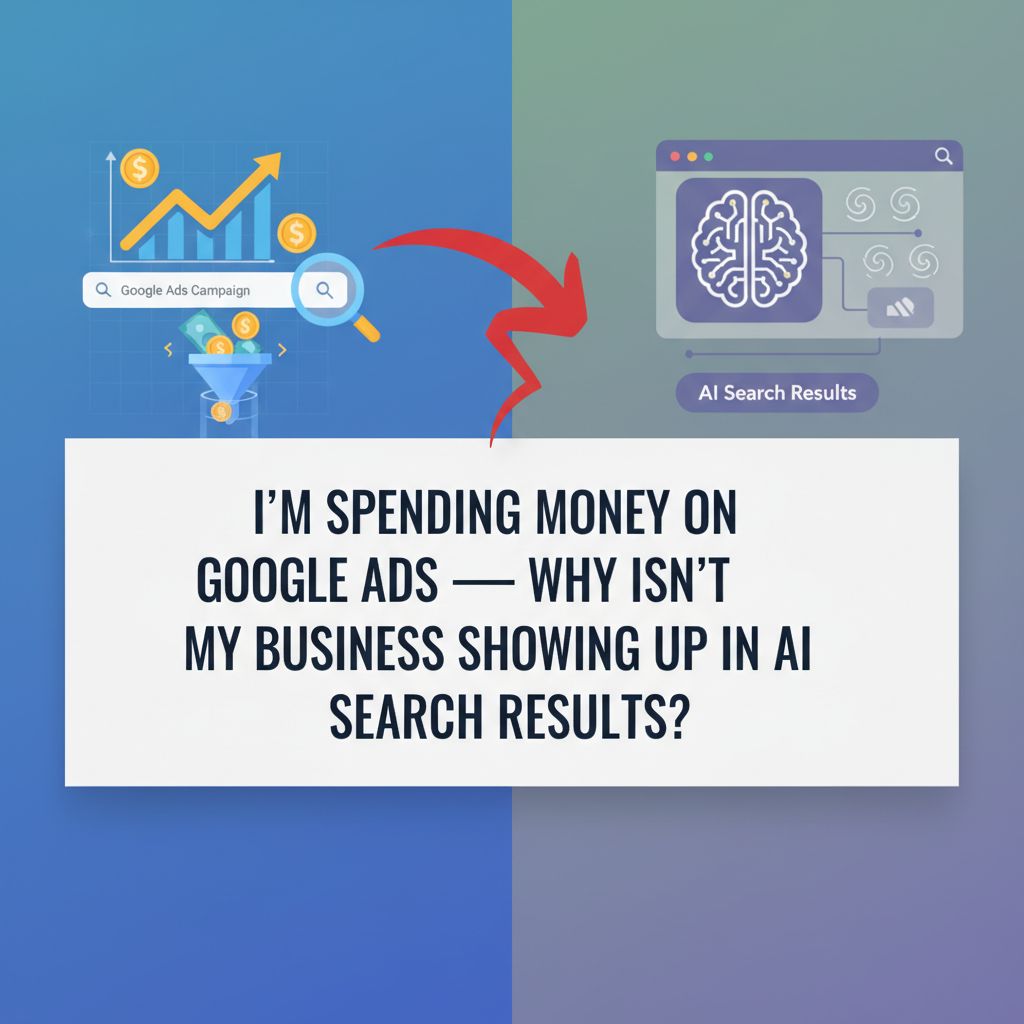
The distinction that matters for this article: ads within or alongside AI Overviews are paid placements. The organic AI citations — the part where AI recommends your business as the answer — cannot be purchased. Those two things look similar to a customer browsing results, but they operate on completely different systems.
Why AI Recommendations Cannot Be Bought
To understand why ad spend does not influence AI recommendations, you need to understand what AI engines actually use to select sources.
ChatGPT and Perplexity: No Ad Channel Exists
ChatGPT has no advertising product that influences which businesses it recommends in conversational responses. When someone asks ChatGPT “what is the best accountant for a small business in Dunedin,” ChatGPT draws from its training data and live web browsing. It evaluates content quality, source authority, third-party mentions, and consistency of information. Google Ads is simply not a variable in that equation.
Perplexity does have an advertising product, but sponsored results are labelled as such and appear separately from organic citations. The organic recommendations — the ones that carry trust — are earned, not bought.
Google AI Overviews: Organic and Paid Are Separate Systems
This is where it gets slightly more complex, because Google AI Overviews do include ads — but in a specific and limited way.
Ads are eligible to show above, below, or within AI Overviews on Search, following the existing auction ranking system and signals. Text and Shopping ads from existing Search, Shopping, and Performance Max campaigns that can win the auction and address both the query and the information in the AI Overview are automatically eligible to show in the AI Overview.
What this means in practice: your Google Ads can appear alongside or near AI Overviews if your bid wins and Google determines your ad is relevant. But this is a paid placement — it is not the same as being organically cited within the AI Overview’s answer. The organic citation — the part where Google’s AI says “according to [your business], the answer is…” — is determined by content authority, schema markup, and E-E-A-T signals. Your ad budget plays no role in earning that citation.
AI Overviews are concentrated in the early funnel informational section, while paid search is primarily in the mid to end funnel. This means the queries where AI Overviews appear most are often the very queries where traditional paid ads have the least influence — awareness and research queries where customers are learning, not yet ready to buy.
The Authority Gap No Budget Can Bridge
Here is the fundamental reason money cannot buy AI recommendations: AI systems are designed to be trustworthy. They are risk-minimising systems. Every business they recommend is implicitly endorsed. If they recommended businesses based on who paid the most, users would stop trusting AI recommendations — and the entire value of those systems would collapse.
So AI engines are explicitly designed to select sources based on signals that cannot be gamed with money: original research that cannot be manufactured, genuine customer reviews accumulated over time, consistent expert content demonstrating real knowledge, third-party mentions from trusted sources that cannot simply be purchased, and structural signals like schema markup that reflect deliberate, sustained effort.
The businesses earning AI recommendations in 2026 built that authority through content, consistency, and genuinely helping their customers. There is no shortcut to that — and there is no ad budget large enough to substitute for it.
The Strategy Shift: From Renting Visibility to Owning It
The mental model shift that changes everything: paid advertising rents your visibility. AEO and content authority owns it.
When you run Google Ads, you are renting placement. The moment you stop paying, you disappear. When you build AI visibility through content authority, structured data, and third-party trust signals, that visibility is yours. A competitor cannot outbid you for it. A budget cut cannot remove it. It compounds over time rather than resetting every billing cycle.
This does not mean abandoning paid advertising entirely. For many businesses, Google Ads remains a valuable source of direct response leads — particularly for bottom-funnel, high-intent keywords where the customer is ready to buy. The mistake is using ad spend as a substitute for building organic and AI authority, rather than as a complement to it.
The smartest strategy in 2026 is a two-track approach: continue running focused paid ads for high-intent, conversion-ready keywords while investing in the content and authority building that earns AI recommendations. Over time, as AI visibility grows, the dependency on paid advertising decreases — and the cost per acquired customer improves.
What You Should Be Spending Your Marketing Budget On Instead
If ad spend is not building AI visibility, what does? Here is where the budget conversation needs to go.
Investment 1: Content That Earns AI Citations
The single highest-ROI investment in AI visibility is creating content specifically formatted for AI citation. This means FAQ pages with schema markup, comparison guides, cost and pricing articles, how-to content with structured steps, and local guides with genuine regional specificity.
Research from Princeton and Georgia Tech found that adding original statistics to content produces a 41% improvement in AI visibility — the single largest gain of any optimisation technique tested. One well-researched, data-rich article published this month can earn AI citations for years. The same budget spent on Google Ads produces zero residual value the moment it stops running.
Investment 2: Your Google Business Profile
For local businesses especially, your Google Business Profile is simultaneously your most powerful Map Pack asset and your primary AI data feed. A fully optimised, actively maintained GBP — with weekly photos, regular posts, consistent review collection, and complete service listings — is the foundation of local AI visibility.
This investment is almost entirely time, not money. And unlike ad spend, the authority it builds accumulates with every update, every review, every photo.
Investment 3: Third-Party Mentions and Reviews
AI engines like ChatGPT do not primarily learn about your business from your own website. They learn from the wider web’s opinion of you — review platforms, directory listings, Reddit discussions, LinkedIn articles, local news mentions, and industry publications.
A business with a consistent review collection strategy, active directory listings, and genuine mentions in trusted third-party sources will earn AI recommendations that no amount of Google Ads budget can replicate.
Investment 4: Schema Markup Implementation
Pages with FAQPage schema markup are 3.2 times more likely to appear in Google AI Overviews than pages without it. Yet only 12.4% of websites have any structured data implemented. Schema implementation is typically a one-time technical investment that pays AI citation dividends indefinitely — the opposite of an ad spend that resets every month.
Investment 5: Topical Authority Building
AI engines strongly favour businesses that have demonstrated deep, consistent expertise in a specific topic area. A business that publishes ten deeply useful, well-structured articles about its specific niche is far more likely to be recommended than one with a single generic homepage.
Allocating budget to a content creation strategy — whether through an internal writer, a freelancer, or a content agency — builds compounding authority that grows over time. Ad spend does not compound. Content authority does.
Should You Keep Running Google Ads at All?
Yes — but with a clear-eyed understanding of what they can and cannot do for you.
Paid ads remain valuable for:
Bottom-funnel, high-intent keywords — when someone searches “book electrician Auckland now,” they are ready to hire. Paid ads for these conversion-ready queries still deliver strong ROI because the user has moved past the research phase AI Overviews tend to dominate.
Brand protection — there has been a noticeable shift towards protecting brand terms, with some businesses increasing brand budgets by up to 20% to maintain visibility when AI-generated answers feature prominently. Running ads on your own brand name ensures competitors cannot hijack your brand query.
Product and service-specific campaigns — Shopping ads and service-specific campaigns for products with clear commercial intent continue to perform, partly because AI Overviews appear less frequently on these transactional queries.
New business, no organic authority yet — if you are a new business with no established organic presence, paid ads provide immediate visibility while you build the content authority that earns AI recommendations over time. Think of ads as a bridge, not a destination.
Paid ads become wasteful when:
- The entire budget goes to broad, informational keywords where AI Overviews dominate and ad CTR has collapsed
- Ad spend is substituting for content investment rather than complementing it
- There is no landing page strategy — sending paid traffic to a homepage with no direct answer structure wastes both the ad spend and the AI visibility opportunity
- The same budget could be producing content assets that earn AI citations for years rather than clicks that last only until the budget runs out
How to Audit Your Current Marketing Mix
Before reallocating budget, it is worth understanding how your current spend is actually performing in the AI search era. Here is a practical audit you can run this week.
Step 1: Test your AI visibility gap
Open ChatGPT, Perplexity, and Google AI Mode. Type the 10–15 questions your customers ask most frequently about your category. Note which businesses appear. Is yours among them? If not — and you are spending money on Google Ads for the same queries — you have identified the gap.
Step 2: Check your ad performance by query type
In Google Ads, segment your campaigns by search term. For informational and research queries (how to, what is, best, compare), check whether your CTR has declined in the past 12 months. These are the queries most affected by AI Overviews. If CTR has fallen significantly, your ad spend on those terms is delivering less value than it was — and redirecting some of that budget to content creation would likely outperform it.
Step 3: Calculate your cost per AI recommendation attempt
For every dollar you spend on Google Ads, ask: does this build anything permanent? Now calculate what it would cost to produce one high-quality, AI-optimised FAQ page with schema markup. That page will earn citation attempts indefinitely. The ad spend will earn nothing the moment the campaign pauses.
Step 4: Identify your highest-converting ad terms and protect them
AI Overviews are concentrated in the informational early funnel. Paid search is primarily in the mid to end funnel. The ad terms that still deliver strong conversion are your bottom-funnel, high-intent keywords. These are worth protecting. The broad, awareness-stage keywords that AI Overviews have colonised are the ones worth re-evaluating.
Frequently Asked Questions
Can Google Ads ever help my AI visibility indirectly?
Only in a very limited sense. Running Google Ads increases the traffic to your website, which can generate more user behaviour signals (time on page, clicks, engagement) that Google may factor into its trust assessment of your content. But this is indirect and minor compared to the direct impact of building content authority, earning reviews, and implementing schema markup. Ad spend is not a viable strategy for AI visibility — it is at best a marginal contributing factor.
If I run ads, will my business appear in Google AI Overviews?
Your ads can appear alongside or near AI Overviews if they win the ad auction and Google determines they are relevant to the query. But this is a paid placement, labelled as an ad, and separate from the organic AI citation within the Overview. Being recommended by the AI answer and having an ad near the AI answer are different things with different effects on customer trust.
My competitor is not running ads but keeps showing up in AI results. How?
Because they have built what AI systems actually reward: content that directly answers customer questions, strong third-party mentions, consistent review collection, complete schema markup, and topical authority built over time. None of those require advertising spend. They require sustained effort and strategic content investment — and they produce AI visibility that no amount of competitor ad spend can take away from them.
Should I redirect my entire ad budget to content and AEO?
Not necessarily — the right balance depends on your business stage, industry, and how much existing organic authority you have. For most established businesses, a rebalanced approach works best: protect your high-intent, conversion-ready ad keywords, reduce or eliminate budget on informational and research queries where AI Overviews dominate, and redirect that saved budget into content creation, schema implementation, and review collection. Over 12–24 months, the compounding nature of content authority typically reduces your paid ad dependency while maintaining or growing overall lead volume.
How long does it take for content investment to replace paid ad traffic?
Realistically, 6–18 months to see significant organic and AI-driven traffic that begins to offset paid ad volume. The timeline depends on your niche competitiveness, how aggressively you publish, and how well your content is structured for AI citation. The earlier you start, the shorter the gap. Businesses that started this transition in 2024 are already seeing the compounding benefits in 2026.
The Bottom Line
The businesses thriving in 2026 are not the ones who discovered a way to buy AI recommendations. They are the ones who accepted, early enough to act, that AI recommendations cannot be bought — and redirected their energy into building the authority, content, and trust signals that earn them.
Every dollar you spend on Google Ads is a rental. Every piece of well-structured, schema-marked, genuinely useful content you publish is an asset. Every review you earn is a permanent trust signal. Every consistent update to your Google Business Profile is a compounding authority signal.
The question is not whether to stop running ads. The question is whether your marketing investment is building something that lasts — or paying for visibility that disappears the moment you stop paying for it.
Start building the thing that lasts. The businesses that do it in 2026 will be the ones competitors are trying to catch in 2028.
Published by Business Startup Support — practical strategies for founders, startups, and small business owners who want to grow smarter. Visit businessstartupsupport.com
Related Reading on Business Startup Support
- SEO vs AEO: What’s the Difference and Which One Should Your Business Focus On in 2026? — The complete guide to understanding both strategies and how they work together
- How Do I Get My Business Recommended by ChatGPT and Google AI Overviews? — The 7 factors that determine whether AI recommends your business
- What Kind of Content Makes AI Search Engines Recommend My Business Over Competitors? — The 8 content formats AI cites most — with how-to instructions for each
- Does My Local Business Need AEO, or Is Google Maps and Local SEO Enough? — Why local businesses need both — and exactly what to do about it
Author

INFLUENCING THE MASSES: The Psychological Techniques a Handful of People Use to Steer Billions of Minds
$19.98 (as of October 7, 2026 16:08 GMT +00:00 – More infoProduct prices and availability are accurate as of the date/time indicated and are subject to change. Any price and availability information displayed on [relevant Amazon Site(s), as applicable] at the time of purchase will apply to the purchase of this product.)
Atomic Habits: An Easy & Proven Way to Build Good Habits & Break Bad Ones
$15.75 (as of October 7, 2026 16:07 GMT +00:00 – More infoProduct prices and availability are accurate as of the date/time indicated and are subject to change. Any price and availability information displayed on [relevant Amazon Site(s), as applicable] at the time of purchase will apply to the purchase of this product.)
Careless People: A Cautionary Tale of Power, Greed, and Lost Idealism
$2.99 (as of October 7, 2026 16:07 GMT +00:00 – More infoProduct prices and availability are accurate as of the date/time indicated and are subject to change. Any price and availability information displayed on [relevant Amazon Site(s), as applicable] at the time of purchase will apply to the purchase of this product.)
The 48 Laws of Power
$11.98 (as of October 7, 2026 16:07 GMT +00:00 – More infoProduct prices and availability are accurate as of the date/time indicated and are subject to change. Any price and availability information displayed on [relevant Amazon Site(s), as applicable] at the time of purchase will apply to the purchase of this product.)


Leave a Reply